

The Low-Maintenance Purple Perennial That'll Keep Your Garden Blooming For Months

If you're someone who wants a flower garden loaded with color but also seek low-maintenance plants, then perennials, which don't need to be replanted each year (distinguishing them from annuals), are the way to go. One of the most stunning perennials you can plant is Culver's root (Veronicastrum virginicum). This flower is incredibly low-maintenance and will keep your garden blooming with purple flowers for months on end. Like many perennials, it's a self-seeding flowering plant (or, alternatively, can be hand-sown from seeds) that will guarantee blooms for years given the right conditions.
Culver's root is a wildflower native to the northeastern United States that has an extensive hardiness range between USDA zones 3 through 8. Typically found in woodlands, wild meadows, or prairie fields, Culver's root is easily identifiable thanks to its height, which maxes out around 5 to 7 feet, and its deep green, tendril-like foliage. Contrasting the foliage are tall, conical, multi-blossomed flowers that typically come in white, blue, or pink.
If you really want to get the most out of these wildflowers, however, you should opt for one of the purple flowering cultivars like Veronicastrum virginicum 'Lavendelturm' or 'Fascination.' The 'Lavendelturm' flowers are spindly and lavender in color, while flowers on the 'Fascination' plant are more bulbous and deep purple. Many Culver's root bloom in June through July or August. To get the most out of your flowers, prune them after the first bloom has ended. This will spur new foliage, and may even encourage a second flowering!
Plant Culver's root to attract pollinators and birds
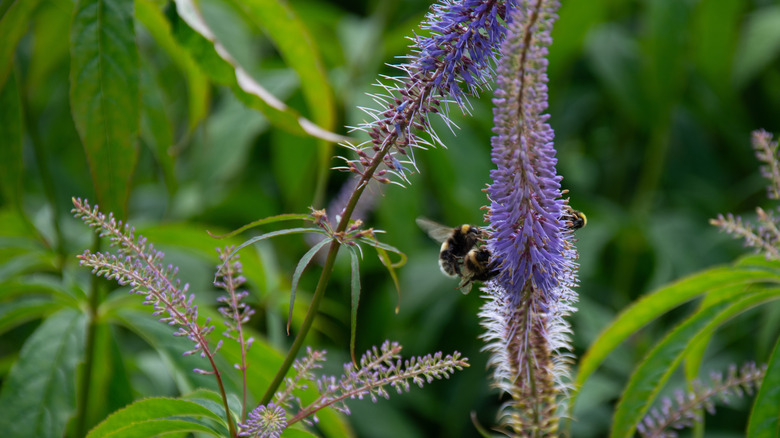
Regardless of which cultivar you choose, most Culver's root varieties have the same general planting requirements. The flowers need to be planted in soil that is moist and well-draining, with a relatively neutral pH level between 6 and 8. The other big requirement is that Culver's root is a full-sun plant, meaning it needs at least 6 hours of sunshine every day in order to grow at its best (though it will perform okay in light shade). A good layer of mulch will help retain soil moisture, but other than that, these flowers don't need much.
Besides boasting beautiful flowers, Culver's root can also greatly improve the health of your wider flower garden. Like Liatris (Liatris spp.) — another easy-growing purple flower — Culver's root is exceptionally good at attracting pollinators. The purple flowers of the 'Lavendelturm' and 'Fascination' cultivars are especially attractive, which is yet another reason to plant them in your yard. Native North American bees and honey bees are particularly drawn to Culver's root, though butterflies like them as well. This makes Culver's root a wonderful, colorful addition to prairie gardens featuring native grasses and full-sun ground cover plants.
Culver's root is also a great flower to plant next to a birdbath. Not only will birds eat the bugs that are attracted to the flowers, but the seeds that come as the flowers fade (assuming you haven't deadheaded blooms) are also great food sources for your avian visitors.