

'More Refined': Reddit Users Say These Are The Best Replacements For Curtains
We may receive a commission on purchases made from links.
There are plenty of reasons, from beautiful millwork to hideous views, to prefer certain window treatments over others. Personal taste is one of the biggest factors, of course, and while it might get trumped by factors like serious privacy concerns or renter-friendliness, a refined look is usually at least in the back of our minds when selecting window coverings. Fortunately, there are a handful of treatments beyond ordinary curtains that — alone or in combination with others — can meet almost everyone's needs.
Likewise, any choice at all is likely to offend someone's sensibilities, and you can always count on Reddit for a good cross-section of positive and negative comments. But Reddit forums like r/InteriorDesign and r/homedesign (and related boards like r/StainedGlass) tend to be measured and constructive, compared with more Wild West-y corners of the platform. Oh, you'll get the occasional person proclaiming that a 10-year-old's stained glass isn't good enough to sell at a craft show, notwithstanding "pity buys," But, for the most part, people try to stay in the neighborhood of social norms.
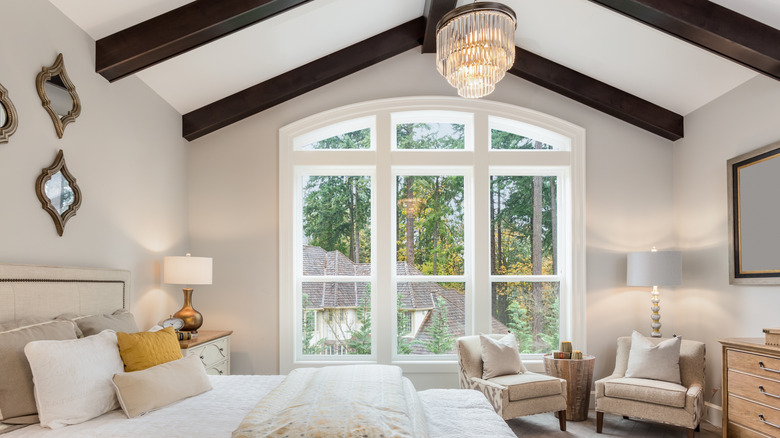
Generous Redditors are quick to point out an often-overlooked option that makes window covering literally as simple as possible. If you have great-looking windows or millwork, or a particularly beautiful view with no privacy concerns, sometimes it's best to avoid curtains and blinds and adopt Joanna Gaines' trick for upgrading basic windows on a budget; simply skip window coverings altogether. For example, one should try very hard to avoid covering windows like the ones shown in this Reddit thread, according to commenters. However, if your windows need a little coverage for privacy, light control, or concealing unappealing views, Redditors recommend these alternatives for those who want to skip traditional curtains.
Plantation shutters
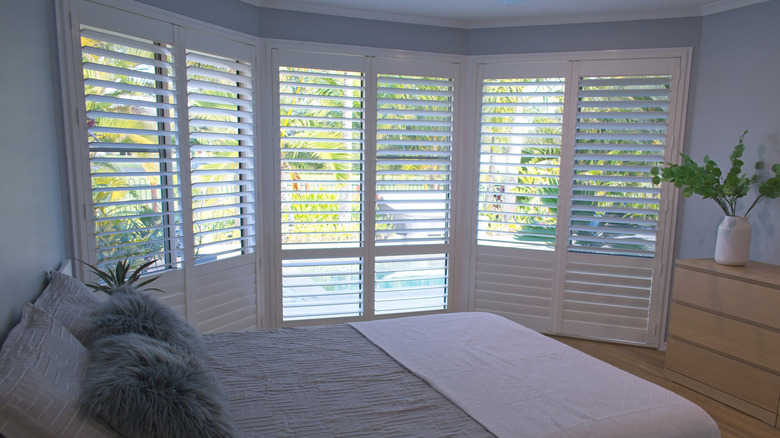
Shutters can be a controversial choice — like any other choice in the polite minefield of Reddit window covering discussions. Some think they look dated, while others find them warm and traditional. But most seem to agree with u/LongjumpingSample937 that plantation shutters "never go out of style and are great for resale value." Of course, one could argue that they're never quite in style, either, but perhaps all those things are what define a classic. If you're not familiar with this particular classic, plantation shutters are interior shutters made up of a frame with working louvers that can be adjusted to admit light, so, they're one of the better ways to cover windows sans curtains or blinds.
While their name and history might suggest a sort of grand antebellum aesthetic, they can work well with a more modern vibe. "Shutters offer a nice minimalist look and feel," wrote Redditor and window company rep u/selectblinds in r/InteriorDecorating. And they're practical, too. "[Made-to-measure] plantation shutters have lots of benefits apart from just looking good. In the summer time they keep the house nice and cool, you get a high level of privacy and they also help noise reduction," wrote u/No_Art3627 in r/AskUK.
Plantation shutters can be pricey, to the tune of $250 to $700 per window, depending on material. Composite shutters are cheaper than wood, last twice as long or more, and they're often indistinguishable. There are labor costs on top of that, but you can save $100 to $200 by installing them yourself if you're comfortable with basic DIY skills.
Roman shades
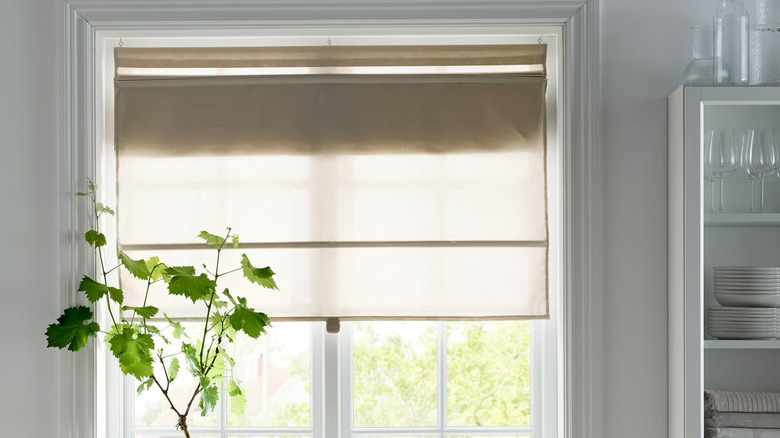
You won't find an actual window treatment fight on Reddit, but you can stir up some dissent by speaking out for or against Roman shades. These shades are made out of just about every material imaginable, but what they all have in common is the ability to be raised into a neatly folded stack (of fabric, bamboo, or whatever) or lowered to lie mostly flat against a window ... for shades mounted inside the window framing, anyway. When Joanna Gaines wasn't leaving windows untreated, it felt like she was installing Roman shades about half the time; for a while, they were usually wooden Quinta Adobe Roman shades. Some find them overexposed and tired, but u/BumbleBeeauty1 has the right response to that in r/DesignMyRoom: "A Roman shade is a classic and timeless window treatment – so it shouldn't be surprising to hear that someone in the past had them." And u/Joy2b agrees, saying, "Roman shades are just uncommon enough that people recognize them and remember the last time they saw them."
Roman shades are, like most window coverings, often made to order for specific windows (including fabric selection), and because of this and the wide variety of materials they're made from, they can be extremely flexible, design-wise. They also come in a variety of styles. According to u/carrotsaretheworst in r/InteriorDecorating, "I think flat fold Roman shades are often a great solution for those that don't like blinds or drapes. They're not stuffy or formal like traditional Roman shades with soft folds." Roman shades can cost as little as $37.99 per window for off-the-shelf IKEA shades, or $500-plus for custom Roman shades.
Top-down bottom-up shades
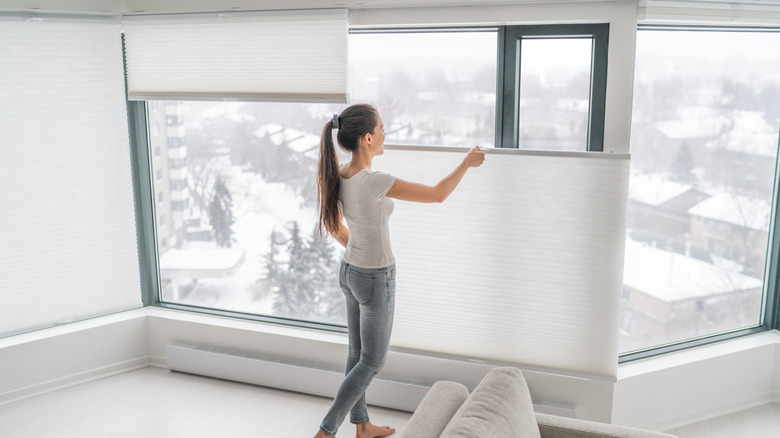
Top-down bottom-up shades are more of a technology than a specific window covering, as they can be based on cellular, pleated, roller, Roman, and woven wood shades. It will surprise no one to learn that they can be raised and lowered from both the top and bottom, allowing you the ability to customize privacy and light-controlling much more finely than with most window treatments. And, like most window coverings, they can be automated to respond to temperature, times of day, room occupancy, etc. As you might imagine, this is a highly functional arrangement with a clean aesthetic. They also tend to stay out of the way of refined millwork. If you're blessed with great windows, says u/Some-Web7096 writing in r/InteriorDecorating, they "would look very nice and still feature your beautiful window casings." It can be a good idea to combine TDBU shades with other treatments to bring the right design emphasis to your windows.
Like solar shades, some TDBU shades are constructed of light-filtering materials that give you finer control over light while adding insulation value. And you can decide both what you see from inside and what others see when trying to look in from outside.
As you might imagine, the cost of TDBU shades varies based on their construction and materials, but the range tends to be less dramatic than many window coverings. You can buy basic TDBU cellular shades for around $40 for standard window sizes, or pay well over $400 for motorized versions.
Stained glass
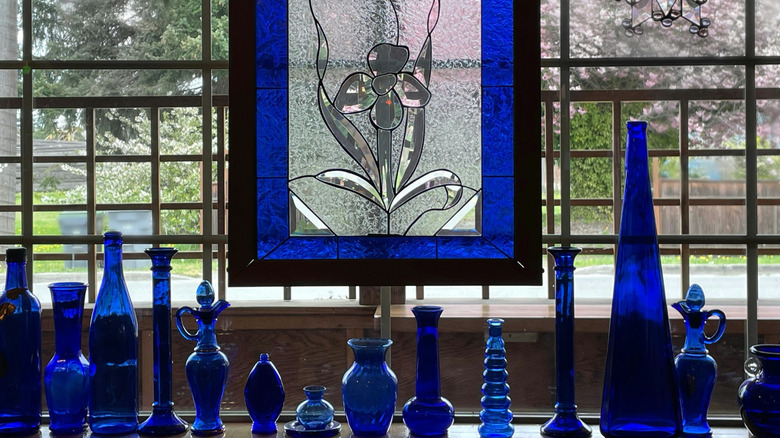
If $400 or even $700 per window scares you, stained glass might give you pause. That's because stained glass typically costs between $100 and $250 per square foot for pre-made windows ... to as much as $600 per square foot for antique or custom stained glass. High-quality, church-sized installations can cost $20,000 — about what a 2026 Hyundai Venue costs new — or even more. They also invariably darken rooms because stained glass absorbs all light except the wavelengths you see passing through.
In spite of all that, stained glass needs no recommendation because its profound beauty is almost universally acknowledged. But even that beauty can have a sort of downside, says Redditor u/THAT_GIRL_SAID on r/interiordecorating: "[Adding stained-glass panels] will introduce art to the room which will set the tone for your decor, so choose the colors and design with that in mind!" This is no small thing, since traditional stained-glass windows are essentially a permanent installation.
As usual, there's always another way, and on r/interiordecorating, u/gusgusfl didn't wait to find another way tomorrow. (Anyone who gets that reference is at least 40.) "For a cheaper stained glass look option – you can buy hooks to screw into the underside of the top frame, buy small stained glass panels with chains, then hang new panels to partly provide privacy," wrote the Reddit user. "The benefit is you can remove it easily if you dislike it or preview it for a more permanent choice." Hanging panels also work well as a unique way to cover small kitchen windows without the use of curtains or blinds. For most of us, this is the way ... or one of them. There are a lot of ways to approximate stained glass as well. Which brings us to ...
Window film
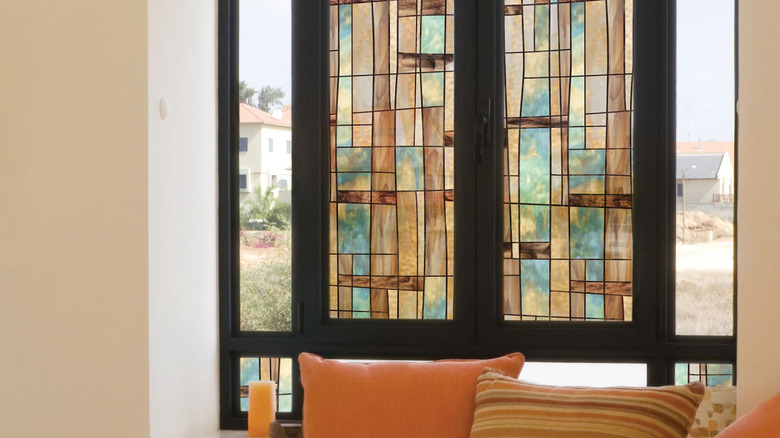
Redditors seem to agree about using window privacy film, which might stem from Gaines' endorsement of reeded glass film as a privacy-enhancing alternative to blinds and curtains for bathroom windows. (Reeded window film is also an affordable and stylish way to cover glass doors.) A now-deleted Redditor wrote in r/interiordecorating that "Artscape makes really beautiful window films that check all the boxes, light shines thru, privacy increase, and with beautiful designs." Most mimic stained or leaded glass, as you'd expect, though many look like etched patterns — like this geometric patchwork design — and a certain genre represents the appearance of things like clouds, rain, and probably scary tree shadows.
But Artscape isn't the only place to find quality window film. Still-extant user u/SweetHomeWherever found a colorful option on Amazon: "I got the rainbow one so neat patterns are on the floor when the sun shines through." But u/Virtual_Library_3443 flips the script: "Instead of rainbow sparkle clings do frosted. It will look more refined and give you even more privacy."
"To fit the era/style of my house I used window cling that looks like bamboo shade," said u/Luna-Luna-Lu on r/interiordecorating, adding the warning that one problem to be on the lookout for is sizing correctly to fit the spaces between muntins. "I have original textured glass in a bathroom and have replicated the same look with vinyl cling in windows at a side door, another bathroom, and basement windows," wrote u/Notime4fools in r/interiordecorating. It's also easy to remove, which hurts less because it's inexpensive. At Lowes, decorative window film runs somewhere between $2 and $5 per square foot. Window-tinting film options you can install for privacy, glare-reduction, and thermal control can cost $5 to $20 per square foot, including installation.