

Ditch Curtains And Blinds: A Gorgeous, More Unique Way To Cover Kitchen Windows
We may receive a commission on purchases made from links.
Stained glass often fits into the popular imagination as a sliver of something dramatic, part of a grand and profound whole. But it doesn't have to be that way in the real world, and it usually isn't. It's delicate or boisterous, and it gets as much of its inherent glory from a handful of colors and the play of light as it does from the bigger picture. In short, the stained glass look will fit perfectly well in a bathroom window or over a kitchen sink. It's not sacrilege to pull down your blinds and put up a piece of stained glass — it's exactly what you're supposed to do: Let the light in while filtering the world out.
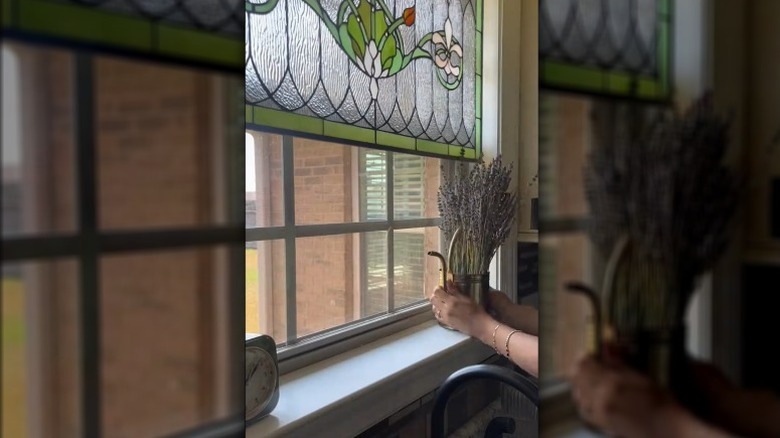
Stained glass transom panels are sometimes called "suncatchers," though the term usually refers to smaller individual stained glass objects that hang anywhere they can, well, catch sunlight. Of course, there is no shortage of kitchen window treatments, but when TikTok creator and maker Saira Steelman (@sairasteelman) decided to replace the blinds and curtains in her kitchen window with a stained glass panel, her goal was to let more light in. It worked, of course, and also admitted some new charm to the room. The panel hangs on a couple of screw hooks in the window's head casing jamb extension (where inside-mount blinds usually attach).
The particular panel Steelman used was very much like this Vevor hanging transom window panel, $124.90 on Amazon. Her Tiffany-style Art Nouveau stained glass suggests — as Art Deco stained glass would even more strongly — the window designs of Craftsman-style homes. With that said, stained glass panels work in the windows of almost any home.
Determine the shape and approach of your panels
The way you use stained glass transom panels totally depends on your needs and preferences. They can be built in or hang at the top, bottom, or middle of your window, or even cover the entire thing. You can install them between the indoors and the out, or between rooms, and they can be riotously colorful or completely without hue or cry. They can be shaped like curtains, inverted arches, or anything else, really. And sometimes, of course, they take the form of entire windows.
You often (but certainly don't always) see colorless "stained glass" panels at the bottom of windows, serving as privacy screens of a sort. Privacy is one of the reasons you might choose a full-window stained glass treatment, but transom panels don't do much for keeping your business in-house. And tempting as it might be, combining one of these colorless translucent panels with a suncatcher-style panel at the top doesn't usually work. So if you have privacy concerns, it might make sense to cover the lower portion of your window with a simple frosted privacy film that won't clash with the stained glass. One commenter suggests cafe curtains for a combination of privacy and cuteness — if it fits your style.
Once you suss out the right general shape and approach, it's time to find something that fits. Standard windows vary in width from 16 to 84 inches or more. Fortunately, since hanging stained glass panels don't have to fit precisely, there's every chance you can find a piece that works for your window.
Finding the right stained glass for your window
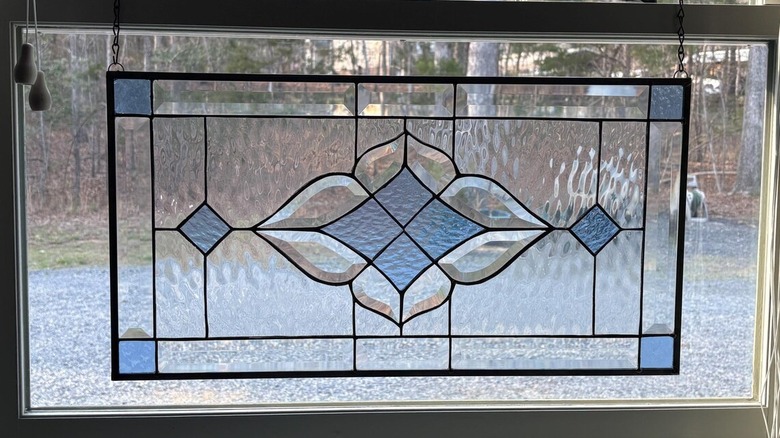
Now it's time to look in earnest for a stained glass panel that catches your eye. There are, of course, the dozens of options on Amazon, and with a little patience, you can find a pretty wide variety. There are simple flowers, enormously complex scenes, postmodern color blocks, purely decorative geometries, new age icons, traditional religious imagery, and just about anything else.
The greatest variety might come from Etsy, where sellers offer stained glass in every form — boutique to mass-produced, vintage to new, small to large — in prices ranging from a few dollars to over $50,000. A commenter on Saira Steelman's video encourages followers to buy stained glass from local artists, which makes good sense if you have them and can afford them. Or you can become the artisan yourself — there are excellent tutorials on YouTube demonstrating exactly how to make DIY stained glass suncatchers. You can also buy "stained glass" panels as window film that could be applied to hanging glass panels, directly to window tops, or directly to and completely covering windows.
Another commenter encourages Steelman to reconsider because of the possibility that the stained glass (or, more likely, the metal strips between the glass pieces) includes lead. Lead is, of course, toxic when ingested. But unless you're building or repairing it, stained glass windows don't have an opportunity to make contact with food or beverages and so are considered safe in homes. In fact, experts often recommend that lead paint not be disturbed unless it could be abraded, as by a door or window.