

A Jar Of Water Is All You Need To Grow More Gorgeous Hydrangeas In September
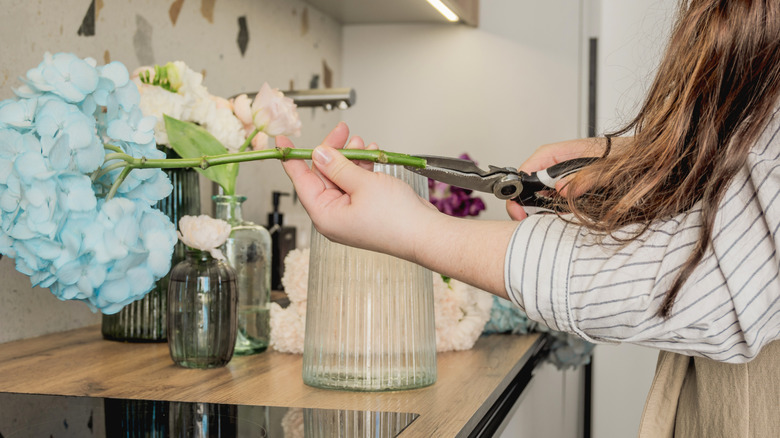
September is an ideal time of year for anyone looking to propagate their favorite hydrangea plant. Propagation is a great way to ensure that you grow even more gorgeous and healthy hydrangeas next spring, and a jar of water is all you need for quick, reliable rooting at the start of fall.
Hydrangeas are among the easiest plants to propagate from cuttings, but before getting your plants into water, you need to look for the right kind of branch. By September, you'll be seeking a semi-hardwood branch, which hasn't fully matured but has a firm base, no flowers, and a slightly flexible top. Using sharp pruning shears, take a 4- to 6-inch cutting just below a healthy leaf node. To encourage rooting, remove the lower leaves, then trim the top couple of leaves in half. This gives you a healthy, bare stem and stiffer portions of top leaves that won't droop and rob the cutting of moisture via excess transpiration.
You can choose to dip the base of the stem in some kind of rooting hormone or compound, but this is optional, though it can speed up the growth of new roots. Make sure the hormone dries before propagating or mix it directly into the water instead. Stick the cuttings directly into individual jars of fresh water which will allow the roots to grow without becoming crowded. Keep them in bright, indirect light and change out the water every two to three days. Expect roots to develop within two to four weeks.
What hydrangea varieties root best in water and how to care for them
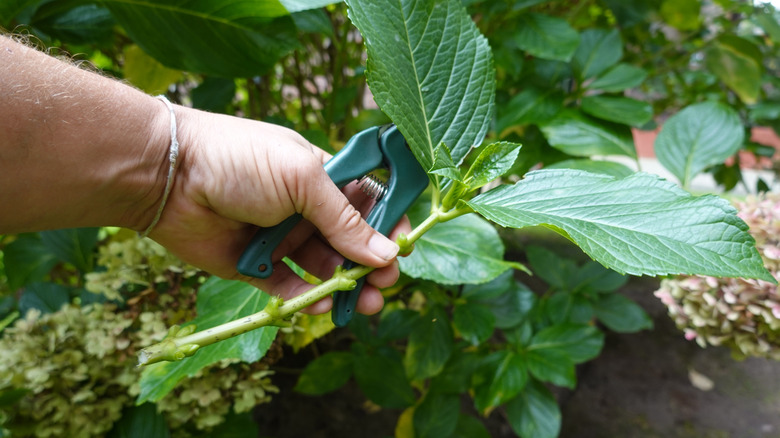
Before you start taking cuttings, or other tasks from your list of things to do to your hydrangeas in September, you might be curious to know which varieties respond best to rooting in water jars. While you can try this method with any hydrangea, the Endless Summer brand of Bigleaf (Hydrangea macrophylla 'Bailmer'), 'Limelight' panicle (Hydrangea paniculata 'Limelight'), and smooth (Hydrangea arborescens 'Annabelle') varieties root exceptionally well in water.
Once the roots have formed, there are a few options you could choose for overwintering. If the cuttings root weeks ahead of your first expected frost date, you can plant them directly in the soil and give them time to further establish their roots before the freeze. You could also overwinter them indoors if necessary, but the roots require a period of winter dormancy and cannot be kept in warm locations. Place them in a cool, indoor room or unheated porch/garage that maintains an ambient temperature between 32 and 45 degrees Fahrenheit. You could also bury the pots in the ground outdoors to keep the roots cool, but insulated from damaging frost.
Now, if you're new to hydrangeas and are not sure what variety you might have growing in your yard, consult your local extension office or ask an experienced gardener for their opinion. Even if you're not sure, try taking a cutting anyway. Whatever variety you're working with, hydrangeas packed full of energy from the summer sun will be prime for propagation in September. If it doesn't root in water, try sticking it in soil and utilizing one of the aforementioned overwintering methods and see what results you get.