

What To Do With Hydrangeas In September To Prepare Them For Next Year's Blooms
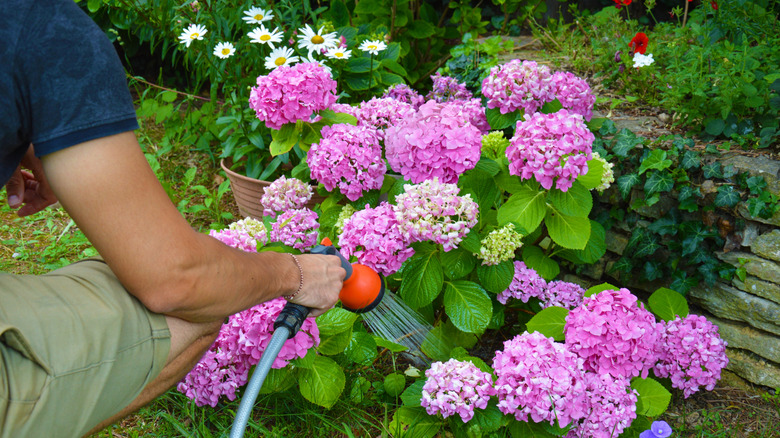
September is a funny time for hydrangeas. Certain types, like smooth (Hydrangea arborescens) and panicle (Hydrangea paniculata), are parading their final colors. Others, like bigleaf (Hydrangea macrophylla), have dropped their flowers and are transitioning into dormancy. It's a critical month because what you do in the garden, like fertilizing, deep watering, leaf raking, and selective pruning, all work together to aid in recovery from a rough summer, prepare your hydrangeas for winter, and help ensure you have great flowering in the future.
Let's start with selective pruning because this is where many gardeners, especially beginners, go wrong in their care for hydrangeas. The two types of hydrangeas are known as old wood and new wood. The old wood growers, such as bigleaf and oakleaf hydrangea (Hydrangea quercifolia), produce their future flower buds in the old wood of the plant shortly after flowering. New wood hydrangeas, like smooth and panicle, grow their blooms directly out of new branch growth each year.
As such, you never want to prune old wood hydrangea in September as that exposes the protected buds to the elements, potentially killing them through winter frost. You honestly don't need to prune these types except to remove dead or diseased branches. New wood hydrangea, however, can be pruned in September, as the buds will not set again until the following spring. This will help the plant direct its energy towards new growth of flowers next year.
Fertilizing, watering, and other September hydrangea maintenance
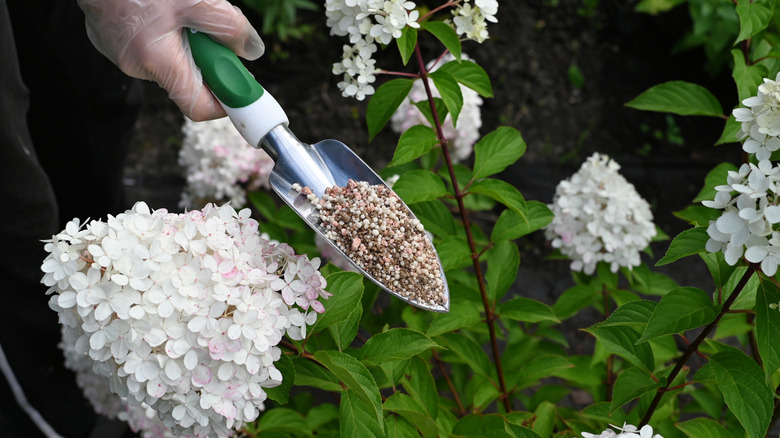
Other September tasks for your hydrangeas include good watering, fertilizing, and mulching. Watering is perhaps the most important thing you can do to protect your hydrangeas. There is a common phrase among hydrangea growers: "Water until the ground freezes." What this means is that you need to keep watering your hydrangeas so that the roots are more hydrated and can withstand winter temperatures far better than if they were not. Lack of watering might cause brittle branches, which can easily be swept away by a winter wind.
Fertilizer is equally important to ensuring healthy blooms for next year. Make sure you find one that is higher in phosphorus, as this will encourage flower bloom. Too much nitrogen will get you excellent foliage, but not so much in the way of flowers. Look for something with a 10-20-10 ratio that will slowly release over the course of the winter. If your soil is not acidic enough, try adding orange peels around your hydrangeas to give them an extra boost.
Adding mulch is also critical as the hydrangeas near dormancy, especially if you live in colder climate zones. A good layer of mulch keeps the roots insulated and fed with nutrients over the course of the winter. When next spring rolls around, you can expect some truly wonderful blooms from your well-tended hydrangeas.