

Skip The Bench Grinder: The Lowe's Find That'll Easily Sharpen Garden Tools
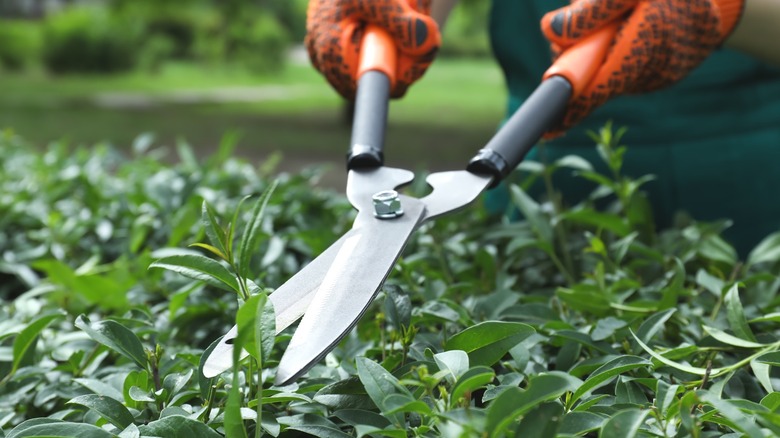
Garden tools are a blue-collar cadre, a "doing the dirty work" selection of cutting tools. Chopping out roots, breaking up compacted soil, and trimming hedges — those kinds of heavy-duty tasks. Mattocks, loppers, mower blades, and garden shears work best when they are sharp, but sharpening them is a task that many gardeners are not comfortable doing, especially with more intimidating shop equipment like bench grinders. There's no doubt you can do a lot with a bench grinder, and in short order. But they are also noisy, present unique dangers, and send sparks flying, so they're not everyone's cup of tea. The good news is that Lowe's has a more approachable solution, the Work Sharp Benchtop Tri-brasive Knife Sharpener, a non-powered, easy-to-use, and affordable alternative.
Those of us with a few decades of work behind us will find the Work Sharp triple-sided blade sharpener familiar. It's reminiscent of the old-fashioned abrasive stone sets enjoyed by knife-sharpening purists. Sets would often include natural stones of differing abrasive qualities that users would progress through to get a sharp cutting edge. The same process works with this Work Sharp product, which features a coarse diamond plate, a fine diamond plate, and a ceramic face.
Unlike a bench grinder, the three-sided sharpener is quiet, does not scatter burning sparks across your shop, and requires less setup to sharpen specific tools. Being so small, you can even take it out to the garden with you to refresh the edge on your shears, trimmers, and digging tools while on the job. Even so, it is not designed to quickly grind away tons of material from a highly abused cutting edge. If there is a lot of damage, a bench grinder may be required.
How does the Work Sharp Benchtop Knife Sharpener work?
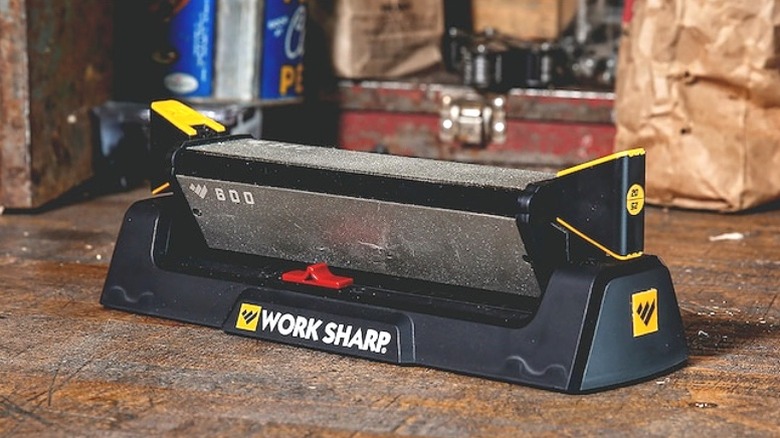
The "tri-brasive" construction of the Work Sharp Benchtop Knife Sharpener features three different surfaces: 320- and 600-grit diamond surfaces and a fine-grit ceramic surface for honing (putting a final polish on an edge). The act of sharpening any tool consists of removing a small amount of metal to restore the original cutting edge. For the best results, you want to preserve the angle that has been ground onto the tool as you do it. Fortunately, the Work Sharp has two angle guides to help with this, a 25-degree and a 20-degree option, which generally align well with the bevel on bladed garden tools like pruning shears and hedge trimmers. The simple system is highly versatile, allowing you to sharpen everyday home and garden tools of all shapes and sizes, the only exception being those with edges that are inaccessible to the sharpening plates.
By aligning the angle of the cutting edge to the sharpening surface and pushing or pulling it along the sharpener, you will create a new, sharp edge. Take a systematic approach, removing any small nicks or deformed areas of the cutting edge. Start with the coarser grit, advance to the finer grit, and polish on the ceramic surface.
Sometimes, you will bring the tool you want to sharpen to the tri-brasive mounted in its base, when sharpening knives or similarly edged tools. In other cases, with an axe or other large or awkward items, you will take the sharpener off of the base, holding it in your hand as you stroke it along the cutting edge. Wear protective gloves when using the tool, and always have plenty of light to illuminate your task when sharpening.