

How One Gardener Turned Simple Glass Jars Into A Hive For Bees To Collect Honey
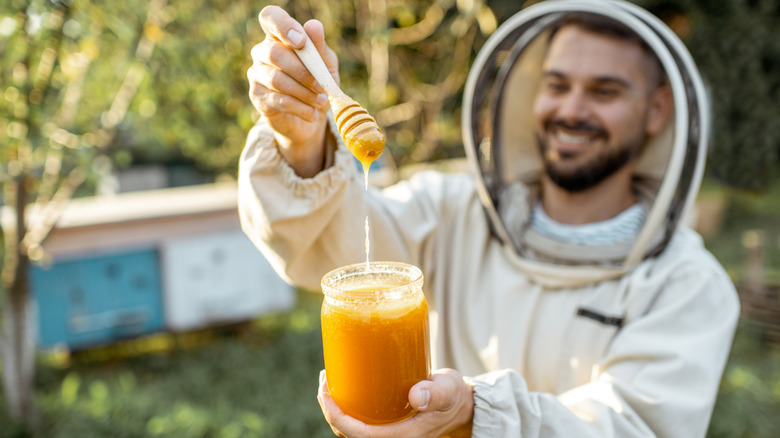
Looking for the buzz on creative honey gifts? Honeycombs dripping in the golden sweet liquid are quite the treat. Bohemia Apiary, based in Maryland, shared a fun way to present comb honey ... and it uses Mason jars. In this bee hive project, the crew turns Mason jars upside down over holes cut into a piece of wood, which sits over the hive. The bees then produce the combs and honey inside the jars, which can be shared as gifts or sold as a honey product, as this company does.
The Bohemia Bees YouTube video notes that this was an idea found online, not an original creation. Either way, it's a quick and simple outdoor use for old Mason jars that you might not think of, even if you do have backyard hives. You'll need several glass Mason jars — nine to replicate the original. The project also requires a large, sturdy piece of plywood or something similar to cover the beehive. A hole saw or Forstner bit attached to a drill works well to cut large holes in the wood.
Keep in mind that the beekeepers that created this honeycomb setup are professionals with established hives. Working around bees can be dangerous if you don't know how to handle them properly. It's common to get stung, even if you're a professional. If you'd rather keep bees away from your yard, stick to buying your honeycomb and local honey from apiaries.
Mason jars over a beehive create a unique honey container
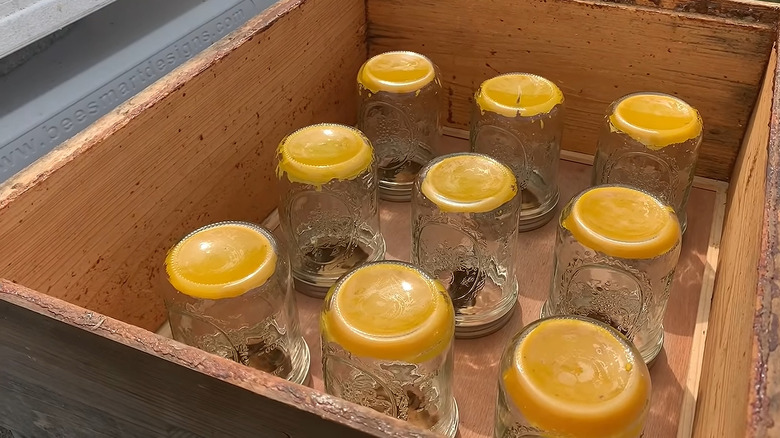
The original video shows a setup with nine Mason jars (just more proof that old Mason jars aren't trash), but the project can be adapted to smaller or larger spaces. Clean the jars well in warm, soapy water or in a dishwasher. To give the bees a head start and attract them into the jar, the beekeepers melted beeswax and poured a small amount in each jar — just a thin layer in the bottom.
Next up, the project requires a piece of wood to cover the hive. That's where the beekeepers cut a hole for each Mason jar. The ring on the jar stays screwed on, so the holes should be slightly smaller than the jar opening — that way, the jars can sit flat on the wood with a wide opening to allow bees to fly in easily. The wood lid goes on top of the hive. The original design also features a wooden frame that's taller than the jars to go around it. It lifts off when needed in case the keepers need to check inside.
To assemble it, the beekeeper simply flips the Mason jars with the rings screwed on upside down over the holes. Some people nail or glue down the jars for more stability. The jars should cover the holes to eliminate any gaps where bees can escape. After a few days, the bees started creating honeycombs inside the jars. A few weeks later, the jars were packed with combs and honey. They shook out the jars and froze them for at least 24 hours to get rid of pathogens or contaminants. To fill up the jar, the apiary added more honey they had already processed.