

The Beloved CorningWare Pattern Secondhand Collectors Are Always Happy To Find
We may receive a commission on purchases made from links.
Leaving the thrift store with an old-school CorningWare accessory in tow is the sign of a successful outing. Whether pieces from the valuable kitchenware brand turn up in second-hand shops or make an appearance at flea markets, collectors have a hard time resisting the classic find — and with good reason. The durable, versatile, and innovative line can withstand anything a recipe might require of a cook, and its quaint aesthetic adds vintage charm to any kitchen, especially the beloved blue cornflower pattern.
Just as the name suggests, the quintessential motif that launched in 1958 features three blue blooms and petals on a variety of white accessories, including casserole dishes, teapots, and pie plates. Though it's arguably CorningWare's most iconic design, the science behind its non-porous Pyroceram glass-ceramic is equally notable, as the material was originally created for missile nose cones during World War II. Pyroceram allows for extreme temperature changes quickly, meaning a CorningWare piece can go from cooking to freezing immediately, cutting down prep time in the kitchen. The cornflower pattern ended in 1988, with U.S. production of Pyroceram ceasing 12 years later in 2000. However, the floral pattern made a resurgence in 2018 for a 60th anniversary collection available at Bed, Bath & Beyond and Corelle, the brand that owns CorningWare. Unlike the original, the line was crafted from stoneware and not the iconic Pyroceram(though that, too, reappeared in 2009).
What makes the CorningWare cornflower blue pattern worth it
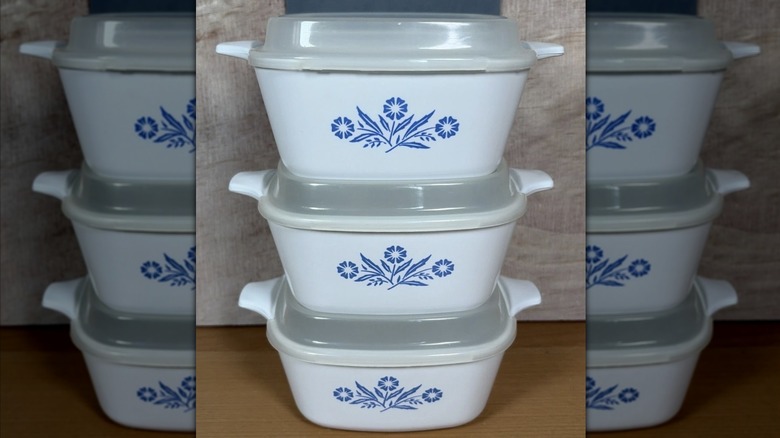
Amanda Keller, a curator at the Colonial Williamsburg Foundation, told House Beautiful that a vintage CorningWare dish with the iconic blue floral is "the most common pattern but is still worth quite a bit of money today." Authentic pre-owned pieces like baking trays and casserole dishes from this line hover in the $30-$45 range, while some can climb into the hundreds, and of course, you'll come across the occasional four-digit price tag. While it is a fairly accessible pattern to acquire for your collection, a few factors will increase the value and price, like the condition, whether or not the piece includes a lid, and if the accessory shape is unique and not as accessible as a casserole dish. Should you find a complete set online, that will hover in the mid-hundreds.
If you've come across what you believe to be Grandma's favorite casserole dish at an antique fair or an estate sale, you'll need to check if it's the real deal. The back of the pieces will either say "Corning Ware" (two words, not one) or "Pyroceram," and some potentially feature the date on which they were made. Some will sport a "P" for Pyroceram as well as a dash and sizing features, like P-43-B, for example. Be on the lookout, as no vintage collection is complete without at least one blue cornflower piece.