

Wood Vs. Lumber: What's The Difference?
As the Bard would have us believe: "What's in a name? That which we call a rose, by any other name would smell as sweet." Still, the question remains a good one; what is in a name? There's a bit of confusion about the terms lumber and wood. As a professional woodworker with decades of experience buying lumber it is not confusing to me. Merriam-Webster tells us that wood is the "hard fibrous substance that makes up the greater part of a tree." Curiously, they define lumber as "timber or logs, especially when dressed for use." I think you can see why this might be confusing; lumber is logs "dressed for use," in other words, wood. Why the distinction? It's the challenge we have with this thing we call language.
Consider, in addition to being a woodworker, you could call me a writer, father, son, uncle, husband, or international supermodel. (That last one would be a lie, but you could still call me that.) Context is the key to when those words would be an apt or useful descriptor for me. (Except for the last one. There's no appropriate context for that.) That's the key to when to use the words wood or lumber appropriately.
Like any craft, especially one with a tremendously long history in many cultures, like woodworking, terms of art specific to woodworking abound. I can use words like kerf, swarf, and arris effectively with my woodworking buddies, but not with most people. (And I have opinions about wood!) It's when those terms of art move outside of our field of interest that the value of the specific terms lose context and importance. Such is it with wood and lumber.
Lumbering through the usages

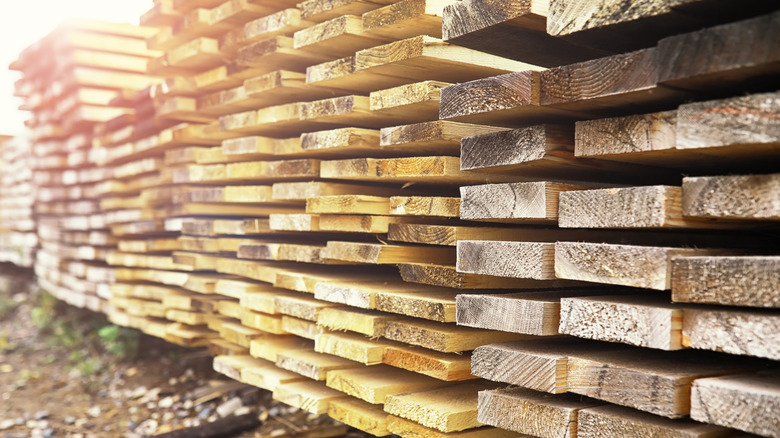
Merriam-Webster is right when it describes lumber as harvested wood, dressed for use. Logs are long round things with limited uses. To make lumber, we cut them up into long rectilinear pieces that we use for myriad purposes. For that reason, the most common use of the term lumber is for cut up pieces of a tree or log that are ready to be used. It's often used to describe an aggregation of boards rather than a singular use (but not always). It's more common (but not universally so) to use the term lumber for wood used in construction, rather than the stock used in furniture making or fine woodworking. The term wood is often used to describe lumber that has been further processed for specific uses. But confusingly, it can describe a chunk of log in the forest or a violin.
Lumber is always wood, but the term wood is not always a synonym for lumber. Wood is a more general term referencing that "hard fibrous substance from trees". There are subcategories of wood such as hardwood, softwood, plywood, and firewood; all further describing that hard fibrous substance. Context, as in language generally, is king. "What kind of lumber is that guitar made from?" is an odd sentence. Though the wood that the guitar is made from was once "lumber" (logs dressed for use), it is more commonly identified as "wood". "The wood I used to make the guitar was African Mahogany," is a more comfortable construction. Terms of art are extremely useful but can be confusing. As the Bard would never have said: "That which we call wood, once and future lumber, came from the same tree and still smells the same."