

Not Granite, Not Quartz: This Durable & Stylish Countertop Option Is Gaining Popularity

While they ultimately serve a utilitarian purpose, your kitchen countertops influence the overall style of your kitchen. Granite and quartz remain popular options, provided you skip the speckled, warm-toned colors that can make your kitchen look outdated. A great alternative countertop material to quartz and granite is porcelain. Not only is it stylish and durable, but it is also gaining in popularity.
Porcelain countertop slabs are made from refined clay that has been shaped and fired at extremely high temperatures. This creates a heat- and scratch-resistant surface. Plus, because it is nonporous, porcelain resists stains.
Porcelain's durability is likely part of the reason why such countertops are expected to reach a $4.8 billion annual growth rate by 2034, according to data from Market Intello. North America represents roughly 20% of the entire porcelain countertop market, which makes clear that it's a popular material that homeowners want in their kitchens.
Porcelain is affordable and eco-friendly without sacrificing style
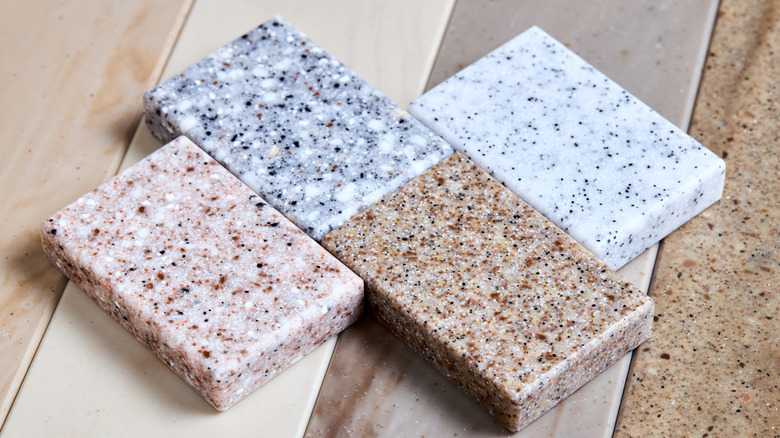
Porcelain is affordable and eco-friendly. Costs are comparable to those of many popular countertop materials, including granite. According to Angi, porcelain averages $50 to $70 per square foot. By comparison, granite costs $40 to $60 per square foot. On the environmental front, porcelain is made from readily available natural clay and minerals, which can be sourced sustainably and ethically.
As for style, you have a lot of flexibility with porcelain. You can order porcelain slabs in a wide range of colors and patterns that mimic the look of gray or black slate, textured marble, and even concrete. Plus, porcelain is much lighter than natural stone. This makes it easier to handle, and it can be used on top of most cabinets without adding extra support. Porcelain can also be made much thinner than granite or butcher block, giving your kitchen a sleek, stylish, and modern look.
However, porcelain is not a perfect material. The edges are prone to chipping if you accidentally hit them with something heavy. And, once chipped, the different-colored porcelain core is exposed, which is almost impossible to cover up again. As such, the edge profiles need to be very carefully chosen and installed with the proper equipment. Overall, however, porcelain is a strong, affordable material that will give you a great-looking kitchen for a long time to come.