

The Overlooked Way To Prevent Weeds Without Herbicides Or Vinegar
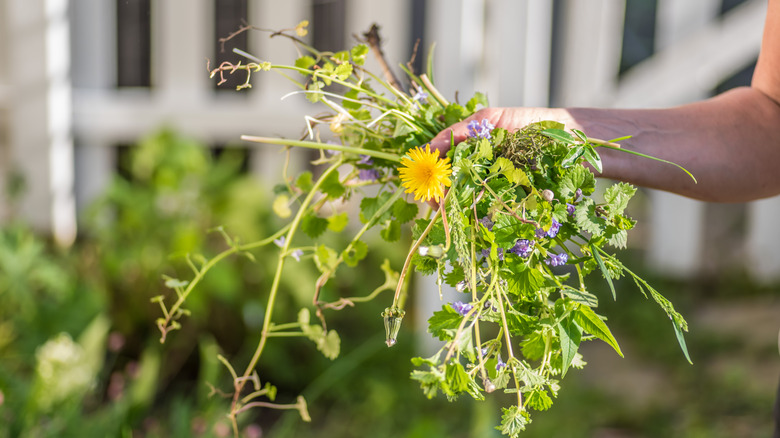
Weeds make life complicated for gardeners. When they crop up in your plot, they take up precious space, nutrients, and water that should go towards the plants you've worked so hard to cultivate. While plenty of weed-killing solutions exist, from common kitchen staples that experts say you can use to kill weeds DIY-style, like vinegar and salt, to herbicides and tools with sharp spikes, there are plenty of overlooked ways to keep pesky weeds out of your garden.
Denying weeds the space to grow is one way to keep them at bay. Intercropping, which is planting two different crops in the same area, is one way to crowd out weeds. It's an essential part of the French intensive gardening method, also known as square foot gardening. But to reap the benefits of intercropping for weed suppression, you need to choose your crops wisely.
At least one of the plants should be a quick-grower that's dense enough to cover the soil, keeping weeds at bay. You also want to choose plants that will play nicely together, rather than compete for nutrients, water, or space. Think low-growing, ground-covering thyme planted near tomatoes or tall and stately leeks, along with leafy celery. Typically, the more diverse your plantings, the better, both for weed suppression and pest avoidance.
How to use intercropping to suppress weeds

When choosing which plants to include in your plot, consider their growing needs and how they might complement each other, while also suppressing weeds. Planting celery and leeks together has been shown to reduce weed cover by more than 40%, for instance. The two crops "work" together because they have similar needs but are also considerably different. Both plants need plenty of water, well-drained, nutrient-rich soil, and full sun. Celery has a shallow root system, as do leeks. However, leeks also have a large stem that grows underground.
In some cases, the plants you choose may not have identical needs, but one plant can support the other. Lettuce is often an ideal companion plant for cucumbers, even though it typically needs more shade and cooler temperatures to thrive. When cucumbers are climbing up a trellis, its wide leaves can provide shade cover to the lettuce, whose growth can then smother weeds that may be trying to sprout up.
For additional weed suppression, at the end of the growing season, consider planting a cover crop, such as clover or peas. The cover crop competes with the weeds for space, crowding out the seeds and taking any nutrients the weed seedlings might require. Plant the cover crop at the end of your growing season, several weeks before the first frost, to give it time to cover the ground before the winter freeze hits.