

Give Your Garden A Major Boost With This Simple 2-Ingredient DIY Fertilizer

Garden fertilizing advice can easily get complicated. Should you repurpose the wood ash leftover from your wood stove? Or should you crush up all your egg shells and sprinkle them in your cucumber patch? There is no wrong answer, as each of the aforementioned methods have their uses for adding essential nutrients like phosphorus and calcium, respectively. However, there is a far simpler, two-ingredient DIY fertilizer that you can make that is going to give your garden a major boost: A fertilizer tea featuring comfrey.
Comfrey (Symphytum officinale) is a hardy perennial that can be grown in USDA zones 4 through 8. It's the foliage of the plant that is going to be the essential component of this fertilizer (water is the other). Comfrey grows in large stalks of deep green, hairy foliage that is loaded with nutrients including being rich in nitrogen, phosphorous, and potassium (NPK) which almost all plants need to thrive. The foliage also contains calcium, manganese, and vitamins A and B12.
One thing to understand about comfrey is that it has a tendency to grow and spread quickly. As such, one of the best ways to manage comfrey is to prune the leaves and their long stalks to the base of the plant several times each season. While you could just toss the leaves into your compost pile — they're an excellent addition — what you can do instead is soak the foliage in water to make a comfrey tea you can use to water your garden plants.
How to make and use comfrey tea in your garden
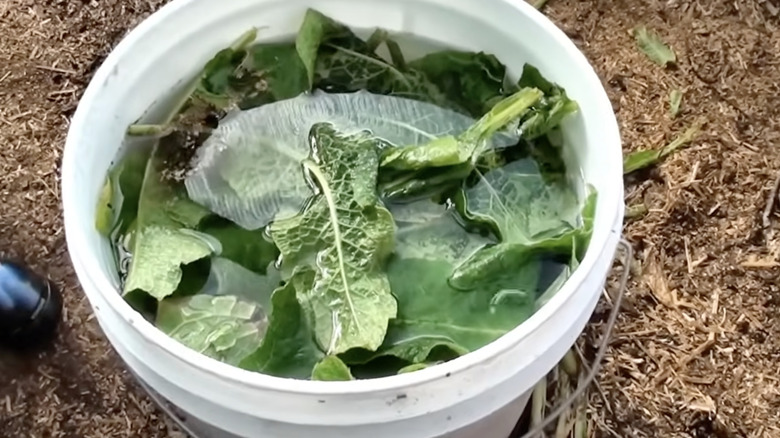
Liquid fertilizers are great because they are concentrated, penetrate the soil more easily, and are absorbed by the roots much faster. Making a fertilizer tea out of comfrey is similar to using leftover kitchen fish scraps to create a potent and highly nutritious emulsion, though it doesn't require nearly as many ingredients.
While there is no need for precision, you generally want to aim for about 2 pounds of comfrey leaves to every 4 gallons of water. Let water sit in a container for a day or so before adding comfrey, to evaporate out any microbe-killing chlorine.
In a 5-gallon bucket, pack comfrey leaves until it's full, adding enough water to submerge the leaves. You can place a brick or large stones on top, if you want, so the leaves stay under the waterline. Cover the bucket and let it steep in sun or partial sun for a month (heads up, it's going to stink as it ferments). You can Stir the mix a few times during the month for aeration, making sure you're getting peak nutrient infusion. The result should be a highly concentrated comfrey tea packed with free, natural plant food. Discard spent leaves in the compost pile, strain, and bottle the tea.
Before use, dilute it with a ratio of one part comfrey tea to 10 parts water. If your comfrey tea is particularly thick, you will need to dilute it further to avoid nitrogen burn. It's especially useful for tomatoes, cucumbers, and many flowering plants. The nitrogen and potassium will encourage more blossoming and fruit production, increasing your yield and keeping the plants healthy all season long. Because the liquid is a fast-release fertilizer, it will need to be applied more often than granular, slow-release versions.