

The Overlooked Solution For Preventing Carpenter Bees Is So Simple
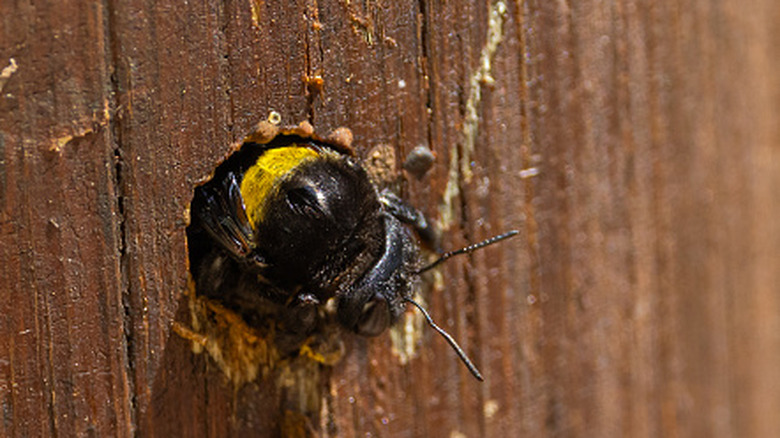
Larger, shinier, and more robust than bumblebees, carpenter bees have a habit of destroying wooden structures. They leave perfectly round holes in the wood to dig nesting tunnels that can sometimes be 10 inches deep. If you've ever heard a consistent buzzing coming from your walls, seen small patches of sawdust, or those aforementioned circular holes, you're dealing with carpenter bees. And while there are myriad ways to repel carpenter bees, the most overlooked way is actually the simplest: don't build with wood to begin with.
Carpenter bees are naturally drawn to dead, rotted, or untreated wood because it is easy to drill into. Decks, sheds, or siding made from soft woods like pine, cedar, Douglas fir, or California redwood are particularly vulnerable. If you know carpenter bees are a problem in your area, it'd be wise to consider building with materials other than wood, such as composites, vinyl, or metals. All of these are resistant to carpenter bees because they are not the kinds of materials the bees are instinctively drawn to.
Now, if you already have a deck or siding that is affected by carpenter bees, you could always replace the damaged wood and give it a new coat of paint or sealant. While this will be effective against them drilling into your deck for a little while, the bees will find a way into the wood if they are determined to nest. So, working with synthetic or metal materials is really the simplest choice to make.
Ways to use synthetic and metal building materials to keep carpenter bees away
While it may be easier to buy naturally bee-repelling almond oil, you will still need to make regular applications in order to ensure they don't come buzzing around. Instead, it's much easier to head the bees off beforehand by building with synthetics. However, there are some ways of applying these materials that are better than others.
Take vinyl house siding as an example. While the bees can't chew through the vinyl, they can still smell that damaged wood underneath. They will seek out gaps in the vinyl in order to get beneath it to the wood. As such, make sure any gaps are properly sealed to keep the bees away.
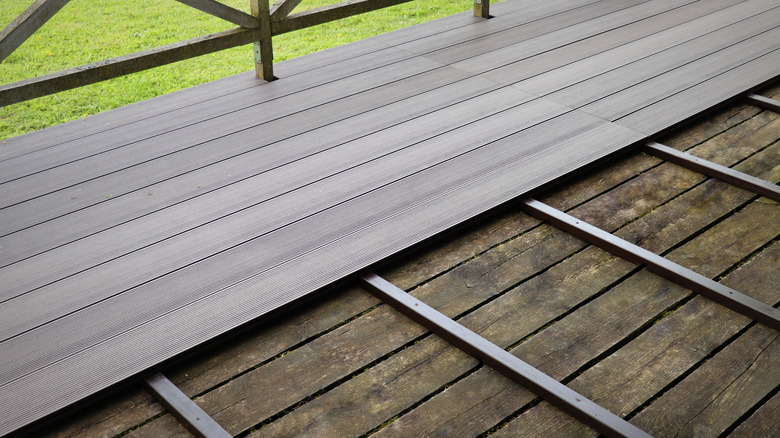
However, it is much better to build with composites from scratch. You can have your home sided with 100% synthetic siding. If your deck is the issue, composite flooring is a popular option. While they can tend to get a little hot in the summer, carpenter bees will not chew into composite or vinyl decking. You can also use metal flashing to surround your deck so the bees won't find their way to the wooden framing, or opt for a metal framed deck. This is more expensive, but it could be worth it to never have to worry about carpenter bees gnawing at your decking ever again and then shelling out money for an exterminator.