

DIY A Faux Concrete Accent Wall That Will Elevate Your Space Instantly

Scared of accent walls? If you instantly flash back to the early 2000s with a bright red wall contrasting beige walls in the rest of the room, you'll be happy to know that you have a lot more options these days. There are still plenty of accent wall colors you'll regret choosing, but modern-day accent walls can still look chic, especially when you incorporate texture. Many homeowners add raised elements, like wood paneling or trim. You can even DIY a stunning accent wall out of pool noodles. But one option we're loving is a faux concrete accent wall. You can complete the application in a few hours, and then it just needs to dry for 24 hours.
The secret behind the rough, gray-tone faux concrete surface is all-purpose joint compound. A few buckets of DAP DryDex Lightweight Joint Compound should do the trick. You'll apply it to the wall with trowels to create that concrete-like finish, complete with ridges and uneven surfaces. And since you'll add in Quikrete Charcoal Liquid Cement Color, you won't have to paint the wall after the joint compound dries. Using three different shades of the tinted joint compound adds to the authentic concrete look.
To set yourself up for success, make sure the wall is clean and smooth, so the joint compound sticks well. Tape off the ceiling, adjoining walls, and base trim to keep the joint compound from going onto those surfaces. Having a few different trowels on hand helps you find what works and allows you to try different application techniques.
How to apply tinted joint compound to create a faux concrete wall
Tinting the joint compound is the first step. Divide it between three buckets, and add varying amounts of the concrete color to get a light, a medium, and a dark tone. You can create a different number of gray shades if you want more layering and variation. As you apply the medium, you'll smooth it on in different directions to create the rough texture. You can also create distinct patterns, like straight lines or swirls. If you're not sure what you like, do a test run on a board.
Start by scooping up the dark joint compound and spreading it across the wall. This first dark layer should be thick, but it's okay if you don't completely cover the wall. Then, add the other two shades, lightly applying them in overlapping areas. Use the trowels to create the texturing and ridges that you like. Now for the hard part: waiting at least 24 hours for it to dry before decorating the wall.
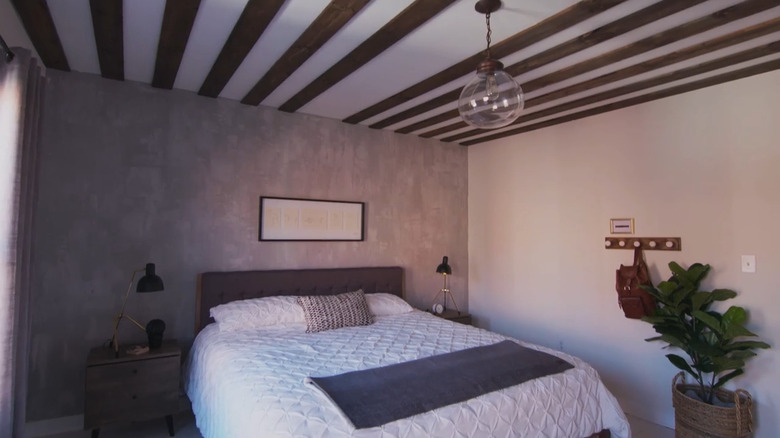
This technique is perfect if you're looking for eye-catching bedroom accent wall ideas. It lends texture to the wall above your bed. To echo the look, try these DIY faux concrete jewelry cones. While they use a different method to create the concrete look, they'll complement your new accent wall perfectly. This finish also looks just as stunning in an industrial-style kitchen or to create loft vibes in a spacious living room.