

Gardener Turns Old Wood Pallets Into An Outdoor Walkway With A Rustic Touch

Are you looking to spruce up your garden pathways but don't want to spend a ton of time and money choosing what kind of material to use? Well, Laura from the Garden Answer YouTube channel has a clever solution using wood pallets to create an outdoor walkway with a rustic touch. Creating an outdoor walkway is an easy DIY pallet project you can create with just a few basic tools.
In a video with over 800,000 views, Laura uses a collection of free pallets and removes the deck boards, which are the thinner pieces that go horizontally across the pallet, using a reciprocating saw with a metal cutting blade to slice through the nails. She then lays out the boards into a winding walkway along a leveled mulched path. Finally, she drills pilot holes into each side of the boards and secures them to the ground with 8-inch plastic landscaping spikes.
In terms of how much this DIY costs, if you have collected the pallets for free from a business or Facebook Marketplace, and already have the tools at your disposal, then the only thing you need to shell out for are the landscaping spikes. A 24-pack runs about $21 at Home Depot, so roughly calculate how many stringers your path will have and double it. You'll need these to keep the boards in place; otherwise, the walkway would be loose and unstable.
Ways to make a wood pallet pathway last outdoors
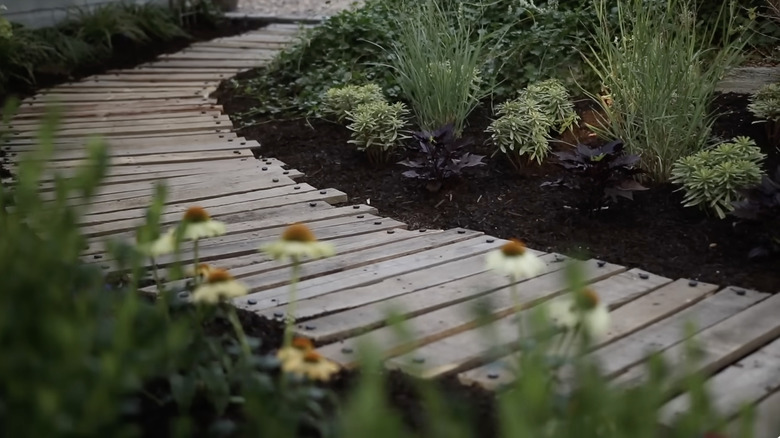
While there is no denying the frugality and rustic ambience of this upcycled wood pallet DIY, there is one substantial issue to point out: wood on soil and mulch. The DIY doesn't include any kind of elevated structure to keep the pallets off the soil. Instead, they are in full contact with the soil beneath. Wood is a hygroscopic material, meaning that it will absorb and lose moisture. If left in constant contact with wet mulch, wet rot can occur within a few years. Not only can this ruin the look of your walkway, but it could lead to its total collapse.
That said, there are a few things you can do to preserve the ease of this DIY and prevent the wood from rotting. The easiest thing to do would be to paint, seal, or stain the wood in order to provide it with a protective layer. Stain will be the best option to maintain the rustic quality of the pathway, but it still doesn't solve the ground moisture issue. Instead of mulch, consider building the wood walkway over gravel. Gravel will drain and dry far faster than mulch, so you're less likely to deal with excessive pooling or moisture contact. However, since this DIY is reasonably cheap, replacing the wood every few years isn't a high cost.