

No Bench Grinders Or Drills Needed: The Affordable, Old-School Way To Sharpen Lawn Mower Blades
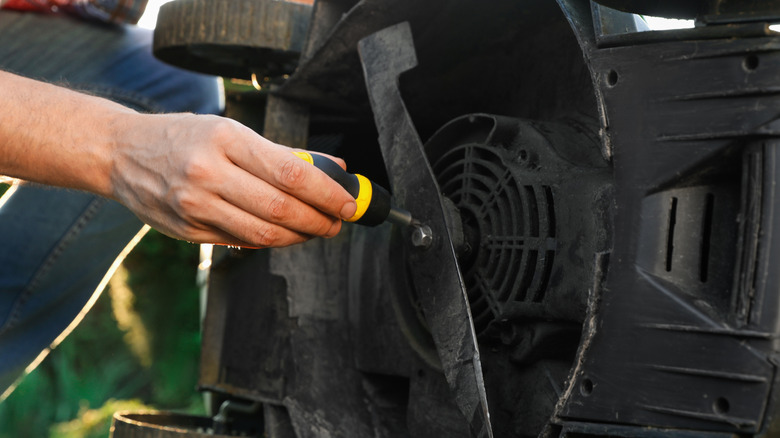
My experience in the landscaping business taught me the importance of sharp lawn mower blades. When you mow with a dull blade, you end up with ragged-looking grass, and more problems crop up as the grass turns brown in spots and needs special care. Not only that, but the mower has to work harder, especially when cutting through long grass, and it uses more fuel. Back in the '90s, when I ran my landscaping business in California, the cost of fuel wasn't the concern it is today, but cut quality definitely was, so I made sure to keep the blades sharp, and quite often, I did it with a file.
A file doesn't sharpen a lawn mower blade as quickly as some other tools, like angle or bench grinders. It takes time, but that's actually a feature, because it's an opportunity to slow down and work carefully. When you use a file, you can examine your progress as you go and get the edge you want without as much risk of over-sharpening your mower blades. Having said all that, a file isn't the tool to use to get rid of deep nicks or gouges on a blade, but after you've dealt with those using a power tool, it's a great tool for finishing up. Like hand-sanding wood, filing smooths out the roughness and gives a final polish.
Tips for filing a lawn mower blade
If you want to sharpen a lawn mower blade without removing it, there are tools for that, but a file isn't one of them. You have to remove the blade and put it in a vise, and that means unscrewing the bolt holding it, which might take some muscle power. Before doing that, be sure to remove the spark plug or battery and make sure the blade is immobilized. Old school mechanics might place a piece of wood between the blade and the housing to stop it from spinning, but it's safer to purchase and use a lawn mower blade clamp.
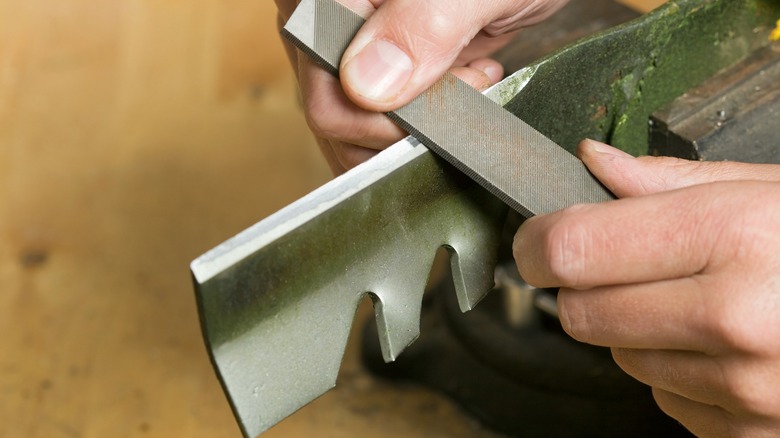
With the blades removed, you'll need a flat file for this job, and they come in various degrees of coarseness. If you have more than one, start with the coarser grade and move on to the finer files. If you're going to keep only one file, make it a single-cut mill file. I like to have a wooden handle, which makes the file easier to use and gives more control, but it isn't a necessity.
To do the actual filing, look closely at the bevel angle on the blade and match the file angle to it. The file should sit flat on the bevel. Put pressure on the file as you push it, releasing as you pull. I actually lift the file entirely on the pull stroke. When you're done, the blade should feel about as sharp as a butter knife and should be ready to reinstall.