

Bench Grinder Or Angle Grinder: Which Tool Sharpens Better?
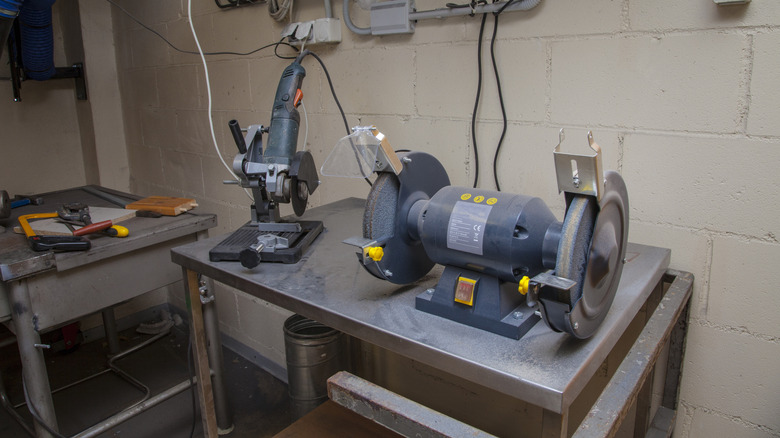
It's a complicated question, or we wouldn't need to ask it: Is a bench grinder or an angle grinder better for sharpening metal implements, from mower blades to chisels to pocketknives? These are completely different tools with different uses ... at least when you use them safely. And the answer is that, generally speaking, a bench grinder is the right choice for most sharpening operations, though there are some exceptions to the rule.
An angle grinder is a high-speed portable device that typically accepts different wheels for different operations, including cutting metal, grinding and smoothing various surfaces, rust and paint removal, and polishing. As you might have already guessed, angle grinders are used at some non-zero angle. Conversely, a bench grinder is fixed in place and runs at a slower speed, though it performs many of the same operations (smoothing, polishing, removing rust) specifically for small parts that can be brought to the grinding wheel. Notably, it's ideal for sharpening drill bits and tools like chisels.
Let's look at some generalizations about the two tools, then dig into specifics. A bench grinder, being fixed in place, is suitable for portable workpieces, including smaller objects. An angle grinder is highly portable, and it's better for cleaning up and removing material from a fixed-position workpiece. This makes the tool more suitable for large surfaces, which doesn't usually include sharpening processes. Finally, bench grinders usually operate at much slower speeds (1,700 to 3,450 rpm) than angle grinders (which start at around 5,000 rpm for big industrial brands and top out at around 11,000 rpm for smaller models and machines used for cutting).
Sharpening under control, and at the best speed
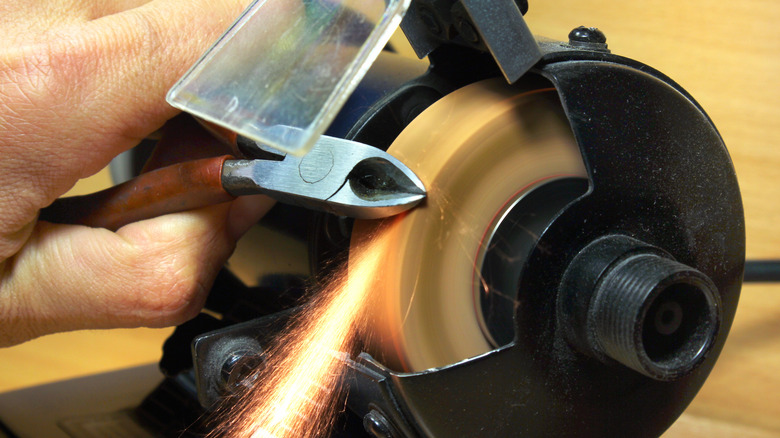
Freehand sharpening is almost never a good idea, and there are lots of reasons why. Everything from mower blades to outrageously expensive chef's knives are sharpened at a specific angle (and sometimes two), so even a small error amounts to reshaping the blade. As a result, precise sharpening tends to rely on some additional mechanism for controlling the angle ... usually a jig, attachment, tool rest, etc. These help you maintain the correct angle when applying a rapidly spinning grinding wheel to whatever item needs to be honed. And, for the record, neither power tool is the ideal way to sharpen kitchen knives (use a whetstone or sharpening steel).
Generally, slow speeds in the 1,700 to 3,450 rpm range are better for sharpening than the high speeds some angle grinders can achieve. There are a few reasons for this. For one, it's easier to control the sharpening process when your grinding wheel is spinning at lower speeds, as it removes material more slowly. It also generates less heat, which is important because high temperatures can undermine the temper of steel, weakening it, and also damage the grinding wheels themselves, making them even more dangerous to use than usual.
One thing to keep in mind about this speed business is that it's relative to the part of the wheel your workpiece makes contact with. That means you can, hypothetically, achieve a slower speed at a point on the side of a grinding wheel — which is, in most cases, a life-threateningly reckless thing to do, for reasons we'll explain soon.
The edge and angle to use for your sharpening job
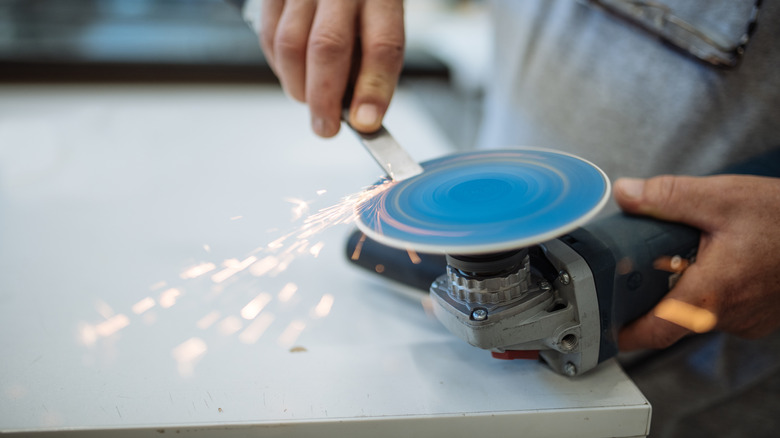
It is possible, of course, to sharpen most things with an angle grinder, so we must spend a little time thinking about the relevant angles. The angle at which whatever you're honing touches the grinding wheel is, as we've said, the key part of the process. For larger workpieces, it's sometimes easier to approximate the ideal angle with an extremely portable angle grinder. While there are angle-controlling jigs for angle grinders, these tools are usually better used with fixed-position bench models or less risky drills and rotary tools.
Bench grinding wheels have a wide, flat circumference. With the help of a tool rest or jig, it's easy to control the angle of sharpening. Angle grinding wheels tend to have a smaller, more rounded edge, and most of their discs are designed to be used at a 30- to 45-degree angle.
When you're using a grinder, you will likely at some point be tempted to use the flat side of your disc to sharpen, shape, or debur a workpiece. This will almost always result in the catastrophic and dangerous failure of a bench grinding wheel, and it's just as unsafe for most angle-grinding models as well. Type 28 grinding wheels can be operated at 0-15 degrees, which allows for side grinding — or sometimes 10-15 degrees, depending on the manufacturer's recommendation. Always follow the manufacturer's guidance with respect to using its products safely. With the exception of these and Type 29 flap wheels that can work at 15 to 25 degrees (which you can use with an angle grinder to sharpen lawn mower blades in a pinch), grinding wheels should not be used flat against your workpiece.