

The Beautiful And Rare Glass Pitcher From The '50s Thrifters Dream Of Finding

We may receive a commission on purchases made from links.
Vintage glassware is everywhere, whether you're regularly scoping out your local thrift store, browsing flea markets, or looking for finds on Etsy or eBay. But, some vintage glassware is harder to find — and worth more — than others. When you come across a rarity, especially a rarity at a bargain basement price, it's a cause for celebration. The Cranberry Opalescent Coin Dot pitcher, made by Fenton Art Glass in the 1950s, is one example.
Fenton Art Glass has been known for producing prized glass items you should never skip at the thrift store, like its uranium glass. The 70-ounce Coin Dot pitcher is another can't-skip product, for a few reasons. Its color, opalescent cranberry, sets it apart from other colorful glassware. The pitcher also had a limited production run. Fenton introduced the opalescent cranberry Coin Dot design in 1947 and discontinued it in 1964. It's not quite clear how long the 70-ounce pitcher was in production, but it did appear in the company's 50th anniversary catalog in 1955. Today, a pitcher on its own may sell for around $100. When paired with a set of matching 12-ounce tumblers, the price climbs anywhere from $170 to $300.
Why the Cranberry Opalescent Coin Dot Water Pitcher is special
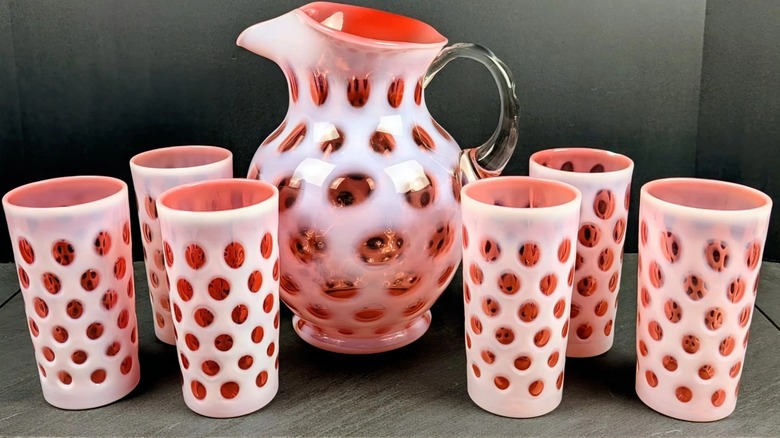
Fenton was known for its colorful glass, whether used for a rare vintage vase or a water pitcher. During the course of its over-100-year history, the company made glass in a rainbow of hues, from brilliant cobalt blue, to vivid green, to cranberry red. It's the cranberry red color that sets the Coin Dot pitcher apart. Fenton mixed gold into the glass, known as gold ruby glass, to make the vibrant hue, so it was a little more expensive to make compared to other shades. The Coin Dot pitcher is made from opalescent glass, one of Fenton's signatures, and another feature that makes it special. Opalescent glass encases a colorful glass in a milky white, creating an interesting effect at the edges and around the dot pattern.
Should you come across a sparkling red, dotted pitcher at your local thrift store, how can you be sure it's the real deal and not a reproduction or knock-off? While you're usually told to look for a stamp, like when identifying valuable vintage Pyrex, that doesn't apply in this case. Before the 1970s, Fenton used pieces of paper to mark its glassware, and most of those stickers are long gone. So, a piece without a mark is more likely to be a Coin Dot pitcher from the 1950s. In fact, if you find a pitcher with the word "Fenton" pressed into the base, it's most likely a reproduction from the 1980s.