

How To Identify Authentic Vintage Pyrex: Tips For A More Valuable Thrift Haul
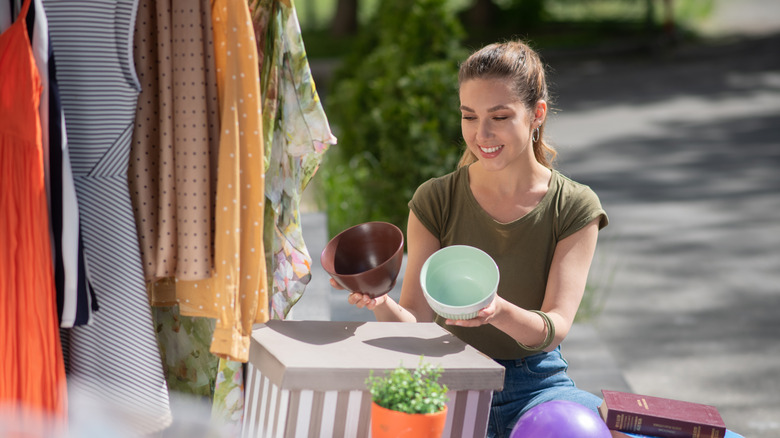
"They don't make things to last anymore" is a common refrain you'll hear from the old gen as they despondently tut over modern-day products. And it may well ring true for Pyrex. Unlike the present-day offerings in the U.S., which are made of soda lime silicate glass, the original cookware was composed of borosilicate glass. And due to the inherent chemical properties, borosilicate can better handle extreme temperature fluctuations and is more durable and long-lasting. However, it was expensive, which explains its substitution in a capitalist economy.
Utility aside, though, the charm of owning an authentic vintage Pyrex lies in its design. Once Corning Glass Works — the makers of Pyrex — injected color and patterns into their wares, it snowballed into over 150 unique designs, birthing a league of ardent collectors. "The collectible Pyrex most people are looking for is opaque white or colored glassware produced by Corning from the 1940s through the 1980s," Virginia Chamlee, author of Big Thrift Energy and the Substack newsletter What's Left, tells Hunker in an exclusive interview. "The patterned mixing bowls, casseroles, and refrigerator dishes are especially sought-after."
To identify and differentiate authentic vintage Pyrex from the modern production, look at its make. "Modern Pyrex is generally just clear glass and has a different look and feel than the vintage stuff," Chamlee clarifies. Another sure sign is the logo. Modern dishes are labeled "pyrex" in lower case, while vintage has them in all caps, i.e., "PYREX." And herein lies the big difference between PYREX and Pyrex.
Finding collectible vintage Pyrex
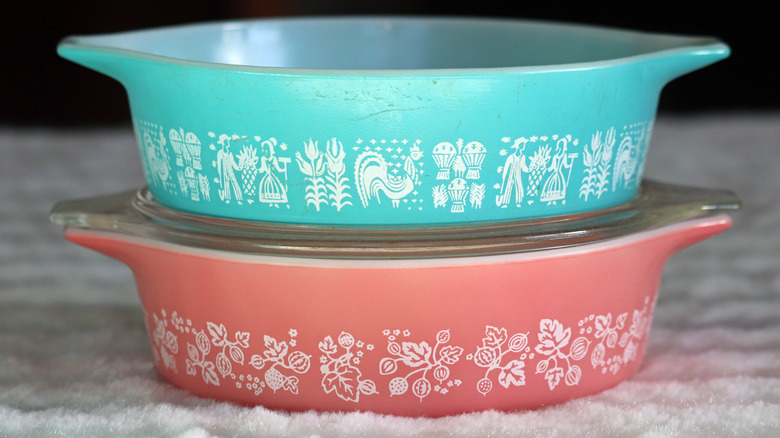
Like all things vintage, not every Pyrex piece is equally valuable, and some designs garner a better price than others. So, to ensure your thrift haul is truly valuable and worth the time, Chamlee advises hunting around for specific pieces. To get you started, she lists "The 'Eyes' pattern, which was produced during the 1950s, and features a turquoise-and-white geometric pattern." She also says that commercial runs of pink patterns like "Gooseberry" and "Butterprint" are highly sought after, making them some of the exceedingly valuable vintage Pyrex items you should never overlook at the thrift store.
Digging deeper into Pyrex's history, you'll discover that they have employed different hues over the years, from primary to pastel colors; the Pyrex Collector has a brilliant database. While these color shifts may be responding to the times, they help date — and value — an older piece. "Color, in general, can make a big difference when it comes to value — some colors are more rare than others," she clarifies. "Also, in general, just complete sets of vintage Pyrex or promotional pieces that were made in specific years." Basically, not many designs enjoyed a long run and were often discontinued within a couple of years. Customized, promotional runs ran even shorter, merely lasting a season, and were sometimes not even released publicly or given official names, making them super rare. "One-year promotional patterns can be particularly valuable because far fewer were made," Chamlee explains.
Authenticating your Pyrex find

With reproductions, first copies, and faux reproductions abound, you'd naturally want to make sure that your Pyrex find is indeed authentic. For that, you must look for a backstamp. "If you find a piece, turn it over and look for a molded Pyrex stamp, model or size number," advises Chamlee. "You can then look up that info on Corning Museum of Glass's Pyrex pattern library." Rather than stamps, authentic Pyrex pieces feature embossed markings within the glass. While they've undergone significant change over the years, collectible color wares typically featured the word PYREX encircled by T.M. REG. on the top and U.S. PAT. OFF. at the bottom. By the 1950s, these were bolstered with registered trademarks and MADE IN U.S.A. text. In the 1960s and later, the text was straightened and enlarged and carried additional information about model and capacity.
Other tips and tricks for spotting valuable vintage Pyrex involve thrifting around in locations that are most likely to carry authentic items in the first place, such as estate sales. "Estate sales are always a good idea, as those pieces will likely be well-kept (you could stumble upon the kitchen of someone who collected it and has various patterns or sets)," Chamlee elaborates. "Church rummage sales, flea markets, and thrift stores are also good options."