

The Delicate Late '70s CorningWare Pattern Secondhand Shoppers Still Hunt For

We may receive a commission on purchases made from links.
If you spot a blue flower pattern on dishware at the thrift shop, don't pass it by. Check it twice, because it may be more unusual than you think. While CorningWare's Blue Cornflower pattern is easy to spot and fairly common, there's one that is rare: Blue Heather. You can identify Blue Heather by the small, star-shaped flowers connected by slender, curling stems and leaves. Its delicate sprigs stand out from the larger, bolder flowers on traditional Blue Cornflower Corning Ware, and its relative rarity makes it a sought-after pattern.
Collectors date the production of Blue Heather to around 1976 through 1979. That's a much shorter production run than Blue Cornflower, which CorningWare ran for nearly three decades. With CorningWare, short production runs aren't unusual. For example, another short-lived pattern, Fresh Cut, shares this trait. A shorter production run, however, might mean that fewer pieces were produced, which can add to its desirability.
Blue Heather was part of the Designer Casserole collection of oval casserole dishes with matching Pyrex lids, and it was also produced on 6-cup teapots. Plates, serving platters, and mugs may also be found in the Blue Heather pattern, but these are actually part of the Corelle line of dinnerware and not true CorningWare.
How to check whether Blue Heather CorningWare is worth buying
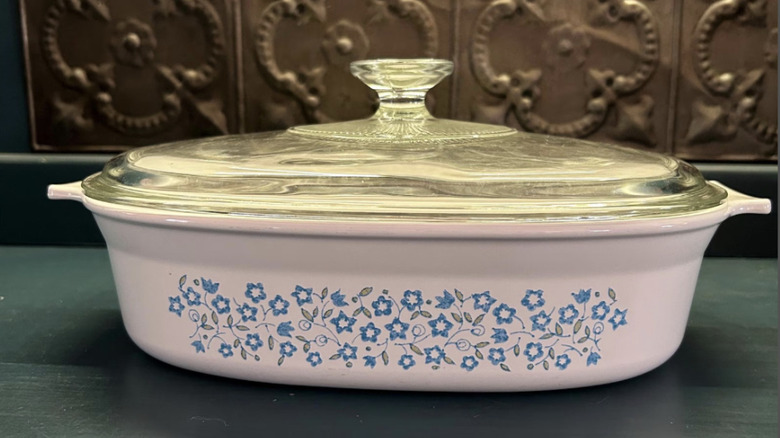
To identify an original Blue Heather CorningWare piece, look for a blue stamp under the dish's handle. It will say "CorningWare" and include the initials "DC" to indicate that it's from the Designer Casserole product line. The original casserole dishes came with matching Pyrex lids. Pieces with matching lids that are free from chips, cracks, or blemishes may be worth more than pieces without lids. Original Blue Heather teapots will be stamped with the code P-104-C.
Pattern rarity, condition, and matching lids add to the overall value of vintage CorningWare rather than the age of the piece, so keep this in mind when you spot it at the thrift shop. Minor utensil marks may be okay, but scratches, staining, and fading could lower the desirability of a piece. It's therefore important to take a look at the rim, handles, base, and interior of a piece of Blue Heather before purchasing it.
Last but certainly not least, consider value by looking at sales prices of the same model, size, and lid combination. An active listing only reveals what the seller wants to get. It does not guarantee that a buyer will actually pay that price, but it will give you an idea of the price range for a particular piece. Potential buyers may also wish to familiarize themselves with several high-value vintage CorningWare patterns before venturing into the cookware aisle. You never know what you'll find when you head out to your favorite thrift shop.