

The Most Valuable Vintage CorningWare Patterns To Look For At The Thrift Store

We may receive a commission on purchases made from links.
In a world where rare, vintage Pyrex casserole dishes sometimes sell for thousands of dollars, it's easy to forget that the beloved American glassware brand has a sister — and some of its sister's products are also quite valuable. Although sometimes an overlooked kitchenware brand, CorningWare has had a number of "greatest hits" over the course of its history, from the iconic Cornflower Blue pattern to the beloved Country Festival to the cutesy Wildflower. Some of its rarer or hard-to-find patterns can command big bucks among collectors. In some cases, even patterns that are pretty common can be worth a fair sum, as long as they are old, in good condition, or a variation on a frequently found pattern. Starburst, Ducks, and Gamebirds are among the patterns that are worth a pretty penny, so watch out for them the next time you're at the thrift store.
That all said, you need to be a bit cautious when seeking out vintage CorningWare patterns. Although Corning stopped producing its casseroles and other kitchenware in 1998, the brand still exists. Modern CorningWare is made from stoneware, not the revolutionary Pyroceram. It may feature some of the classic patterns, but isn't nearly as valuable. Examining pieces closely, looking at the backstamps and for other details will help you know if you've got a real-deal vintage CorningWare dish on your hands or not.
Floral Bouquet
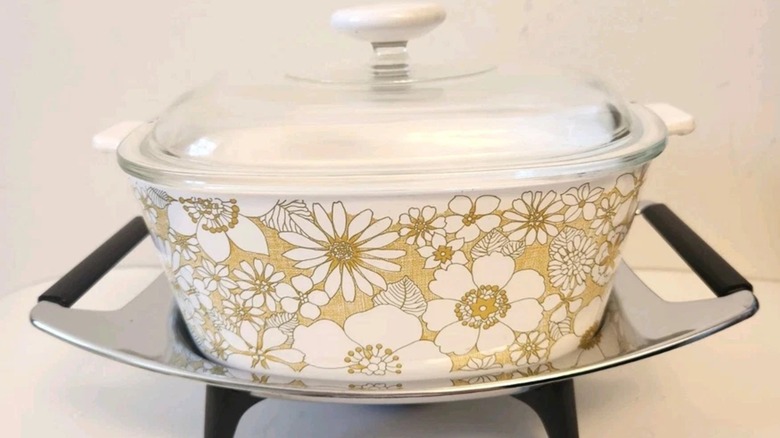
Like its big sister Pyrex, CorningWare occasionally released variations on a pattern, or released certain styles as promotional pieces. That's the case with its popular Floral Bouquet pattern, which comes in three forms. The first, released in 1969, was available as a limited edition item. It has line-drawn flowers against a linen-look yellow background. Later versions had a solid yellow-orange background, or, after 1971, a plain white background and fewer flowers. Dishes with the earliest variation of Floral Bouquet can sell for around $200, compared to $20 to $30 for the post-1971 variation.
Starburst
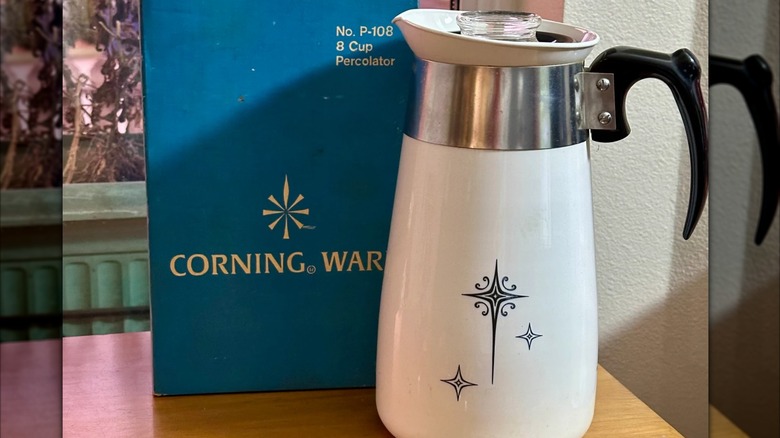
Grab the popcorn and get ready for some drama. In 1979, CorningWare issued a voluntary recall of its coffee percolators, due to a construction defect that could cause the handle to separate from the pot. That means its percolators, particularly those with the Starburst pattern, are a vintage CorningWare dish you'd be excited to find at the thrift store, due to their relative rarity. Another feature that makes the Starburst pattern pretty rare is that it was only used on the percolators, not casserole dishes. Starburst can be hard to find in the wild, but if you do, expect a price around $100.
Duck
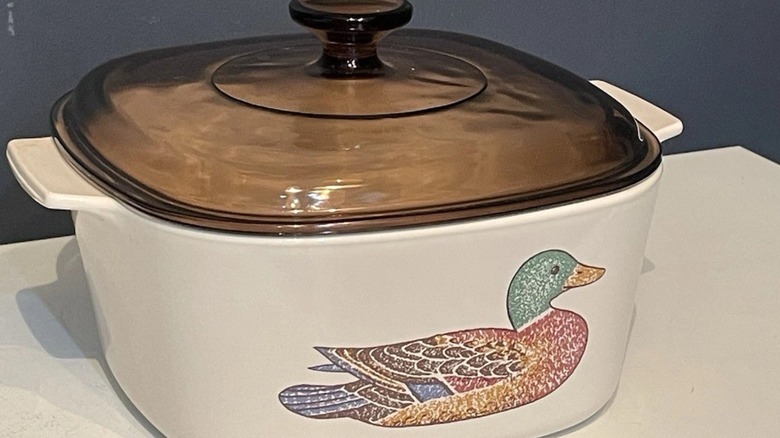
If it looks like a duck, then it's probably CorningWare's Duck patterned casserole, available with a tinted, rather than clear, lid. Produced sometime before the mid-1990s (as that's when CorningWare discontinued the use of tinted lids), the Duck pattern was meant to coordinate with the design found on Corelle dishes. It features a single, slightly speckled, mallard duck on the front. The somewhat mysterious pattern is relatively rare. Depending on the size of the casserole, dishes with the Duck pattern sell in the range of $225 to $300, with a set possibly worth nearly $900.
Gamebirds
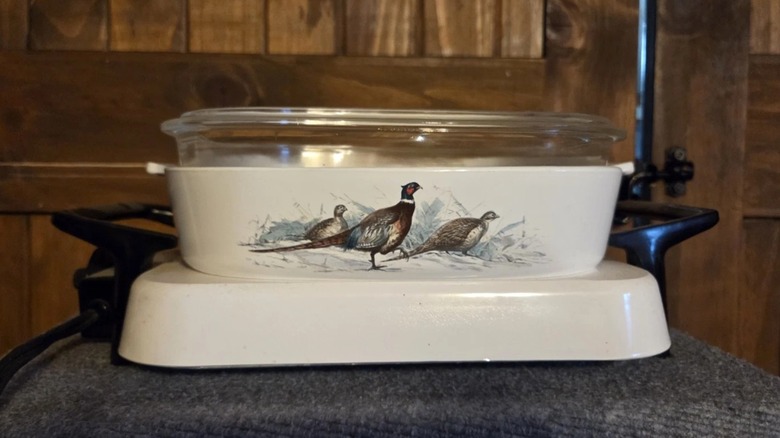
To continue the fowl theme, Gamebirds is another pattern, or rather, series of patterns, that's hard to find and valuable. It was available on dinner plates through Corning's Centura line (which shouldn't be confused with Corelle), and as various casseroles, often sold with warming plates, grills, or chafing dishes. Dishes with the Gamebirds pattern had ducks, pheasants, and partridges flying across them. Not too much is known about the why and when of the pattern, but it could have been CorningWare's attempt to tap into a trend, as several other dinnerware brands also produced patterns with fowl on them. It's rare enough that it doesn't pop up for sale often, but a recent eBay listing wanted $425 for a casserole with warming plate.
Renaissance
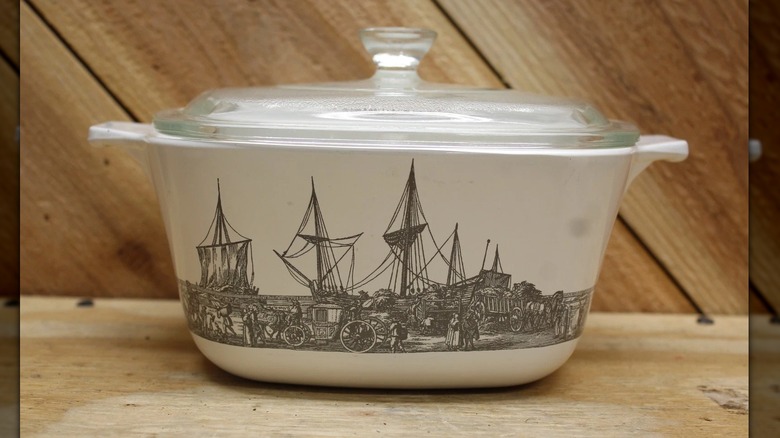
While the big-name CorningWare patterns, like Spice O' Life, had production runs that lasted years, a few patterns, like Renaissance, were blink-and-you'll-miss-them. Its short production run is in part what makes it one of CorningWare's more valuable casseroles. Renaissance came out in 1970, as part of CorningWare's gift line. The design, which features boats docked at a port, was apparently taken from an etching found in an antique Swedish book. It's not just its short production history that makes Renaissance stand out, and command between $100 and $300 per dish. The style is also notably different from other CorningWare pieces, which tend to feature flowers, birds, or vegetables.
Chelsea
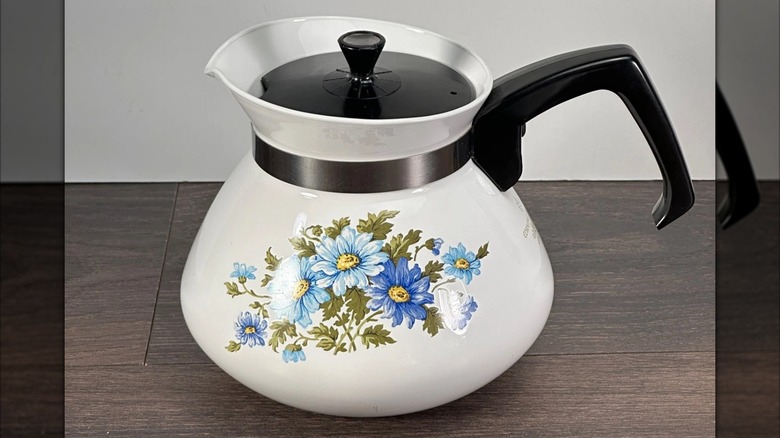
Sometimes called Chelsea Blue Daisy, the Chelsea pattern is pretty rare, and was most likely printed on only one piece, a six-cup teapot. While not much is known about the pattern, it was likely made after 1972, due to the teapot's model number. It features a bouquet of bright blue flowers on two sides of the pot. The teapot doesn't pop up for sale too often, but when it does, the price range is usually between $85 to nearly $150. It's not unheard of to snag a deal and find one for around $50.
Cornflower Blue
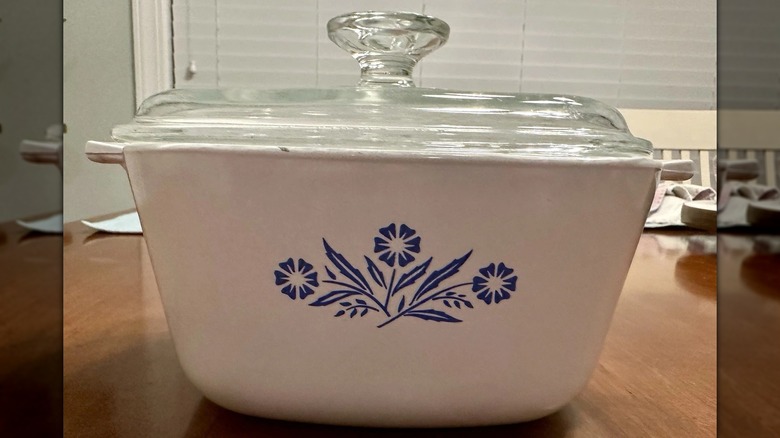
Cornflower Blue is CorningWare's signature pattern. It may be what most people picture when they think about the brand. You can easily get your hands on a casserole with the design for $20 and change. But, seeing as the pattern was in production for 30 years, there is considerable variation in the value of pieces featuring it. Get your hands on a piece from pre-1960 and you can expect to pay at least $100 for it, depending on size and condition. Looking at the backstamp or marking on the dish tells you its age — pre-1960 pieces have an embossed stamp on the bottom.
Black Star
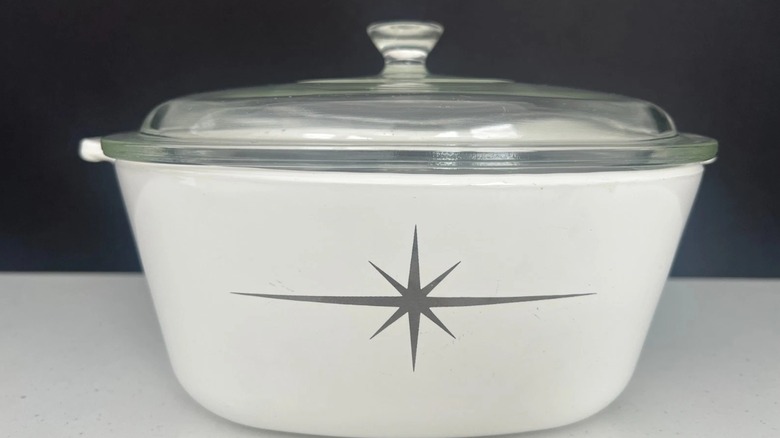
Not to be confused with Black Starburst, Black Star is a mysterious CorningWare pattern that can command anywhere from $250 to $300 at auction. What sets Black Star apart from other CorningWare pieces is its relative mystery. The pieces are unmarked, so it's hard to know when they were produced and why. There are multiple dishes with the pattern, including the typical casserole dishes, plus a flat roaster, small saucepan, and percolator. The design was possibly created as an exclusive for company employees or a test piece that never saw full production.
Say It With Flowers
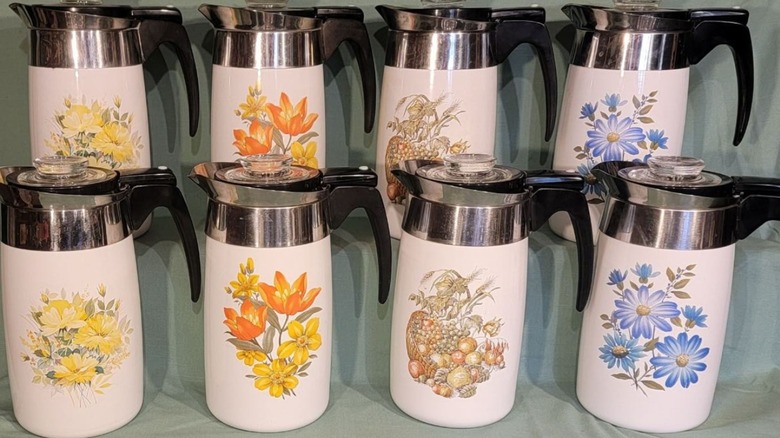
In 1971 and 1972, CorningWare released the very limited "Say it With Flowers" series, which featured four floral patterns on its electric percolators. The designs were given a seasonal theme: "French Spring," "Tropic Summer," "American Autumn," and "Nordic Winter." Since the patterns were only found on the P-80 percolators, and those percolators were later recalled, it's very difficult to track down any of the "Say it With Flowers" series. Some avid CorningWare collectors consider getting their hands on any one of the designs, not to mention a full set, a holy grail quest. While not the percolators themselves, a one-off, employee-designed grab it plate, featuring the American Autumn pattern, was recently listed on eBay for $150.