

Not Just Aeration: The Important Next Step To Smooth & Level A Bumpy Lawn

We may receive a commission on purchases made from links.
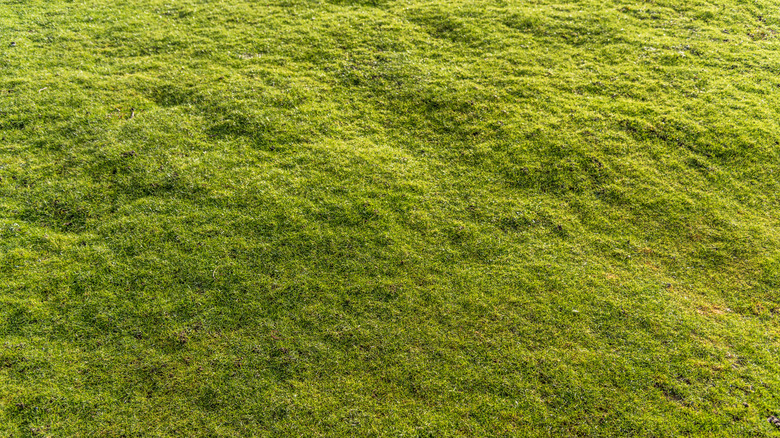
A bumpy, uneven lawn can trip you up — both literally, and in the sense that it will leave you scratching your head about how to fix it. Freeze-thaw cycles and tree roots are often to blame for seriously uneven yards, but soil compaction is another very common cause. It occurs naturally over time, aggravated by poor drainage and heavy foot traffic, leading to low, hard spots. The best solution to compacted soil is core aeration, but there's an important next step after you aerate to smooth out bumps: power raking.
The goal of power raking is to remove thatch buildup. Thatch is the layer of dead turfgrass that slowly accumulates on the ground level. After you core aerate, check the soil plugs the aerator throws out. You should see the thatch layer of dead grass sitting on top of the soil layer. Thatch buildup leads to a generally uneven look to your lawn, as well as preventing needed nutrients from reaching your turf's roots.
Fortunately, you can remove this layer of dead grass using a power rake. Your first step should be to core aerate to relieve compaction and even out the soil layer. Then, follow up with power raking to remove thatch and smooth everything out. After you core aerate, but before power raking, you may want to gather up some of the soil plugs and put them in any low spots in your lawn. A power raking afterwards will break up those soil plugs and help distribute your soil more evenly.
Dethatching versus power raking
Dethatching and power raking are often confused. While the goal of both is the same, to dethatch a lawn, they involve different tools. Dethatchers, or scarifiers, are lightweight manual or electric tools that will only remove about a ½-inch layer of thatch. Power rakes are, you guessed it, power tools that can dig out thatch layers that are up to 1½ to 2 inches thick using heavy mechanical flails.
If you haven't removed your thatch layer in a long time, or ever, you should probably start by power raking. You can usually rent a power rake by the day from a home improvement store, or hire a local landscaping company to do it for you. Just make sure you ask them for a power raking service, not simple dethatching.
For more periodic lawn maintenance, you can remove thatch yourself using a dethatching rake, like this Misopily 70-inch Steel Handle Lawn Thatch Rake from Home Depot, or a lightweight corded dethatcher like this WEN 16-inch 15 Amp 2-in-1 Electric Dethatcher and Scarifier. If you don't feel like shelling out for an expensive new tool, you can also use attachable lawn mower blades to dethatch your lawn. Regular core aeration and power raking can do a lot to smooth out and level your lawn. But to fix a severely lumpy lawn, you may need to knock down high spots and put topsoil down in low spots.