

One Of The Most Valuable CorningWare Patterns To Look Out For At Your Local Thrift Store

We may receive a commission on purchases made from links.
Sometimes the cookware aisle at the thrift store can look like endless piles of worthless white casserole dishes. But don't rush through it next time — there could be a hidden treasure among the stacks. CorningWare is often one of the most overlooked kitchenware brands; some pieces can be worth a pretty penny. Many older dishes were made from Pyroceram, which is basically a nonporous glass-ceramic that could withstand sudden temperature changes and resist stains. But just because you find a piece of CorningWare doesn't automatically make it valuable. Rarity, pattern, size, condition, and the presence of the original lid all matter when determining what the dish is worth.
One of the most valuable vintage CorningWare patterns to watch for is the Duck. Dishes with this highly sought-after design are beige and feature one slightly speckled mallard on the front and come with an amber-tinted Pyrex Fireside lid instead of a clear one. The lid is the key to identifying a complete, original piece as Duck was only issued with Fireside lids. Its exact production dates remain somewhat of a mystery, but one collector database classifies it as a pre-1996 Lifestyles pattern because those tinted lids were discontinued after 1995.
That scarcity has led sellers to market individual Duck casseroles for approximately $225 to $300, while multi-piece sets may be listed for close to a whopping $900. So if you remember seeing one in your parents' cabinets or recently spotted one at a yard sale, it may be worth snagging for your collection (or to pay next month's rent).
How to identify and value Duck-pattern CorningWare
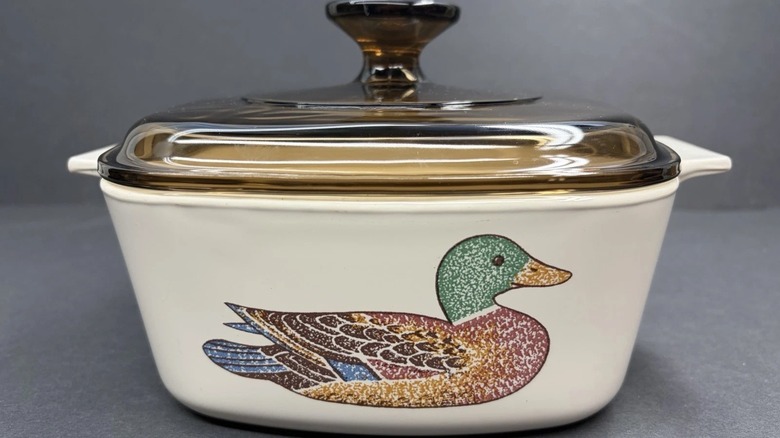
Authentic Duck-pattern CorningWare is decorated with a single speckled mallard, rather than several birds flying across the dish. The bird has a teal head, a red and gold breast, and brown wings with blue tips. It may also be called the Mallard Duck pattern, so try both names when researching it. If you're looking for value, the original brown-tinted Pyrex Fireside lid needs to be included. While a clear replacement lid will definitely fit, it makes the piece less desirable to collectors.
Turn the casserole over and check the markings on its base. Known pieces from online sources include the 1½-quart A-1½-B, 2-quart A-2-B, and 3-quart A-3-B casseroles. The original 1½-quart lid is marked A-7-C, while the larger dishes use an A-9-C lid.
Conditions can make or break the value. Check out the duck for fading and carefully look at the dish for chips, cracks, or discoloration, as a pristine dish with its matching Fireside lid will be more collectible. When pricing yours, compare recently sold listings on sites like eBay or Facebook Marketplace for the same model. And if you do decide to sell your findings, make sure to include photos of the backstamp, lid code, pattern, and every single flaw. Grandma's favorite casserole dish could be more valuable than anyone realizes, but buyers will probably want proof of its condition and authenticity.