

Breaking This Unspoken Rule Could Explain Why Grass Keeps Clumping On Your Lawn Mower
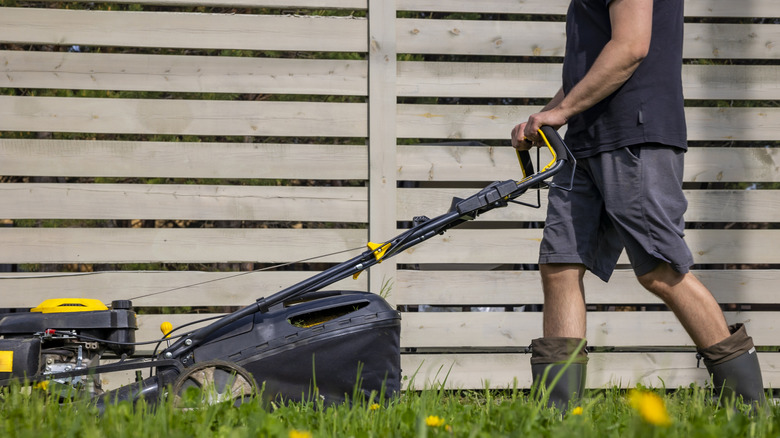
Grass clumping underneath your lawn mower or falling in thick rows doesn't necessarily mean that you need a new machine or a nonstick spray – you may simply be moving too quickly. The general rule is your ground speed should match the condition and thickness of the grass being cut.
As the mower moves forward, its blade must cut, lift, and discharge a constant supply of grass. Pushing or driving too quickly through thick growth feeds the deck more material than it can process effectively. Instead of leaving through the discharge chute or entering the collection bag, the clippings circulate underneath the deck, stick together, and eventually drop in clumps. Leading brands recommend slowing down when cutting long or dense grass.
There is no single correct walking or driving speed. In a dense section, reduce your pace until the machine stops laboring and the clippings leave in a more even stream. With a self-propelled or riding mower, lower the drive speed. With a push mower, simply walk more slowly. Slightly overlapping the previous stripe also gives the deck a narrower strip of grass to process.
Ground speed should not be confused with blade or engine speed. Follow the user manual for the correct operating setting while reducing how quickly the machine travels across the lawn. This distinction is one of several ways to keep grass from sticking to a lawn mower.
Adjust your cut if slowing down does not stop the clumping
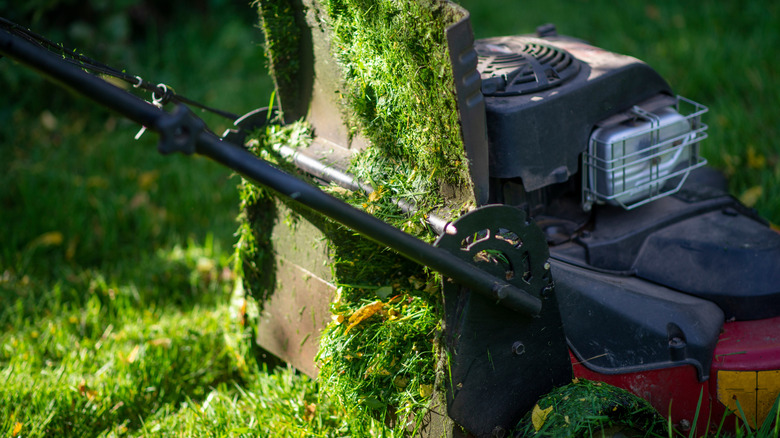
Test your speed on the densest portion of the lawn before mowing the entire area. Make a quick pass and check the results. If clumps remain, you can cut at a slower speed or start overlapping the earlier stripe. When the discharge is consistent, use that speed in other thick sections.
Grass height is another important factor. Apply the standard rule: Don't remove more than one-third of the grass height in a single session. If the lawn has become overgrown, use the maximum cutting height and go slowly, then trim again at a lower height. Another way to produce shorter clippings is to mow more often. Removing too much at once is one of the lawn mowing mistakes that can damage your yard.
Additionally, cutting the grass while it's dry will help prevent moist clippings from clogging the machine, forming plugs, and even stalling the engine. However, dry grass can still clump if the mower needs blade sharpening. Thankfully, mower blade sharpening is a simple task that can be done with basic tools. Before cleaning and inspecting the device, turn off the power and wait until all parts come to a complete stop.