

Funnel Spider Webs: How To Identify One In Your Home Or Yard

Not all spiders weave the thread-like, wheel-shaped webs you find high up in the corners of ceilings or window frames. There are actually several distinct kinds of webs, with four of the most common overarching categories being orb webs, tangle webs (or cobwebs), sheet webs, and funnel webs. Each one has unique characteristics to help you identify the different types of spider web in your home and yard. When it comes to funnel webs, they may sound unfamiliar, even menacing, but chances are you've come across them before. Aptly named, funnel webs are tubular and thickly woven webs with an entrance at one end, shaped like a funnel to trap prey inside. While funnel spider webs can be found indoors, mainly in cool, dark corners, they're often found in vegetation like grass and shrubs, along with flower beds, stacks of firewood, and other miscellaneous outdoor areas.
From afar, funnel webs and sheet webs can easily be mistaken for one another, given their thickness and typical outdoor location, but the circular opening is the key differentiator that indicates a funnel web. Funnel-weaving spiders lurk inside these openings, waiting to catch insects. Funnel webs are largely woven by spiders in the Agelenidae, Dipluridae, and Hexathelidae families, as well as the hobo spider, which is commonly found in the Pacific Northwest. Grass spiders, one of the most common spiders you'll find in and around your home, also weave funnel-shaped webs.
Do you need to exterminate funnel-weaving spiders?
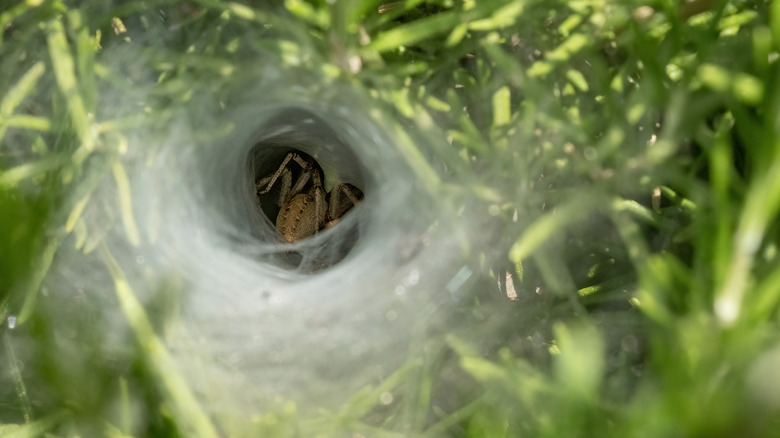
If you're having trouble identifying the types of webs in your house, it's possible to figure it out based on the spiders themselves. While there are various types of funnel-weaving spiders, they tend to be small- to medium-sized spiders with mottled brown or grey bodies. Given their coloration and patterning, grass spiders and wolf spiders can be mistaken for one another. However, one major difference lies in the webs. Wolf spiders don't weave webs, whereas grass spiders and other funnel weavers produce those dense, tube-like webs designed to catch prey — ideally far away from humans.
Fortunately, funnel-weaving spiders tend to be harmless to humans, at least in the United States. The Australian funnel-web spider is an extremely dangerous and venomous breed, but it's separate from the species found here. In fact, funnel-weaving spiders in the U.S., like many other types of spiders, act as natural pest control, keeping various insect populations in check. Funnel-weaving spiders typically aren't aggressive toward humans, and their fangs are often too small to break skin anyway. As a result, there's no urgent reason to eradicate funnel spider webs you find in your yard. Of course, you probably don't want any eight-legged creatures lodging inside your house — unless you have a pet spider, that is — so you may need to figure out ways to get rid of spiders if you see a funnel web.