

Wolf Spider Vs. Grass Spider: How To Easily Tell The Difference
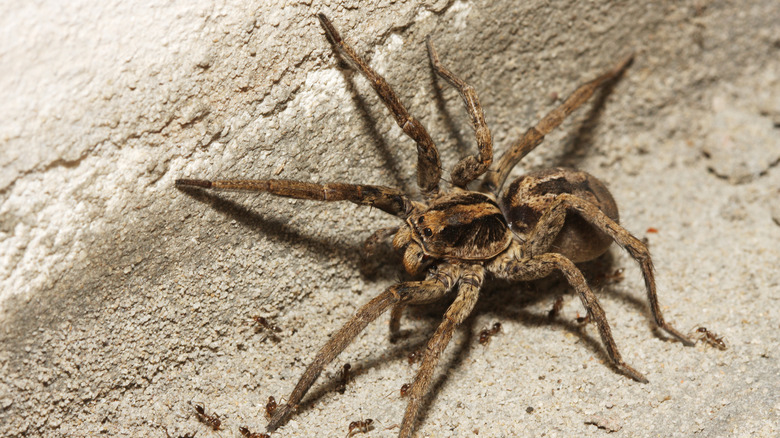
Spotting spiders in or near your home can be startling, but most spiders aren't actually a cause for alarm. Identifying the type of spider can tell you what to expect, how to handle it, and whether you should be worried or not. However, some spiders can be trickier to tell apart than others. Wolf spiders (Lycosidae spp.) and grass spiders (Agelenopsis spp.) are two of the most common types of spiders, and they look quite similar with their brown coloration and striped patterns. The good news is that neither is harmful to humans, and both are actually useful for controlling pests. But if you still want to be sure which you have lurking nearby, and you're able to get a clear view, start by looking at the spider's size and shape.
Wolf spiders are generally larger than grass spiders, sometimes growing to just over an inch long. However, some species of wolf spider can be smaller, and young spiders won't be as large. Rather than relying just on length, look at the proportions of their bodies. Wolf spiders are thicker, while grass spiders have a more elongated, narrow body. If you still aren't sure, check the back of the spider's abdomen. Grass spiders have large spinnerets that stick out of their back end, almost like a tail. Wolf spiders have much smaller spinnerets that often aren't visible or are difficult to see. If you can't stand to look at the spider for long, looking for the spinnerets is a quick way to tell them apart.
Behavioral ways to differentiate wolf and grass spiders
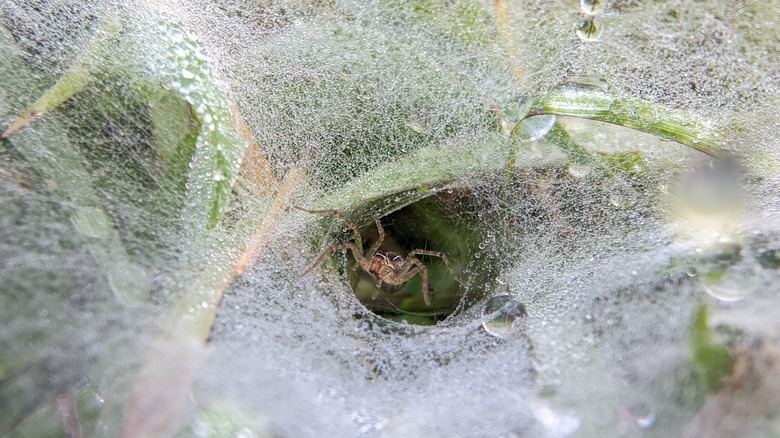
If you only caught a glimpse or can't stand to look at the spider at all, you can also use their behavior to tell wolf spiders and grass spiders apart. Starting with the most obvious; those large spinnerets that grass spiders have aren't just for show! Spinnerets are how spiders spin their webs, and grass spiders catch prey by building sheet-like webs with funnels to hide in. Wolf spiders generally don't spin webs, although there are a few species that do. Considering that there are over 2,000 species of wolf spiders in the world, a couple hundred of which live in the U.S., the overwhelming lack of webs provides a good rule of thumb. If the spider has a web to retreat into, it's probably not a wolf spider. It may or may not be a grass spider, so you might also need to learn how to identify spider webs if you need to know for sure.
Both wolf spiders and grass spiders are shy and will run away if disturbed, but you can also distinguish them by where they were when you encountered them. Grass spiders tend to stay hidden in their webs. They may be in the grass, under a bush, or in a brush pile. By contrast, you're more likely to spot wolf spiders running around, as that's how they hunt. Once you've identified the spiders around your home, you can choose to let them stay and take care of any pest problems you have. If not, you can use these natural pest control solutions for spiders.