

Not Wedgwood: The Valuable Antique Teacup Brand That Collectors Dream Of Finding
We may receive a commission on purchases made from links.
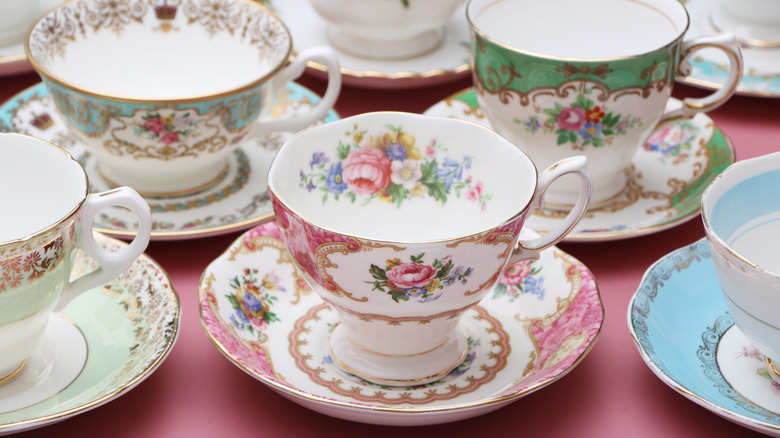
Anyone who regularly hunts for antique teacups knows that Wedgwood is among the most valuable vintage dinnerware to look for at a thrift store. The brand's history and renowned quality make some pieces worth upwards of $1,000. However, Wedgwood is not the only valuable antique teacup brand collectors dream of finding. Meissen is another historic brand that offers timeless designs and high quality.
Created in Germany in 1708, Meissen became the first producer to successfully make European hard porcelain in the style of the Chinese porcelain that was popular at the time. The brand, which is still in existence to this day, became known for its designs, which ranged from ornate mythological scenes to simpler floral patterns. These were hand-painted on plates, bowls, platters, saucers, and teacups. Older Meissen from the early 18th century into the 19th century is defined by these more ornate designs, while the 20th century favored a more contemporary look.
Regardless of the time period, however, the Meissen brand is synonymous with quality in the antique porcelain world, and the auction/online retailer prices reflect that. It's not uncommon to find single antique teacups and saucers being valued at over $400, and for complete tea sets to be worth $3,800. Basically, these aren't the kinds of teacups you'll be upcycling into whimsical home decor. They're the ones that, if found cheap at a thrift store, you'll be passing down to generations of your family.
How to identify an authentic Meissen piece
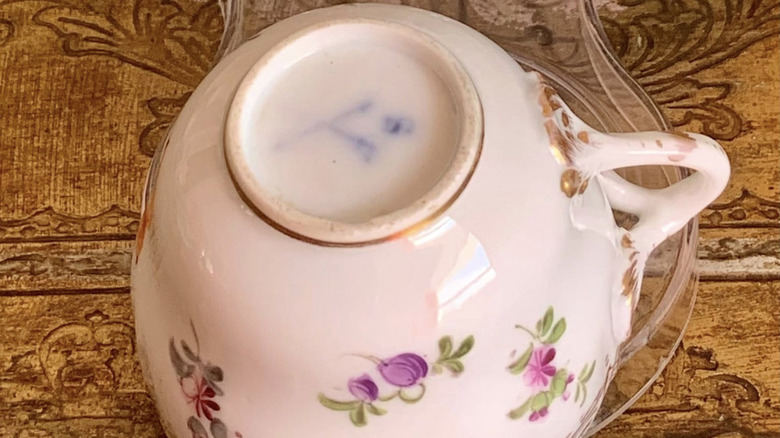
There are many different ways to determine whether a vintage piece is worth the money. With Meissen, you need to look for the crossed swords. This motif was inspired by the Saxon coat of arms and first appeared in 1722 as a mark of authenticity against other porcelain competitors that were rising at the time. It's said to be one of the oldest trademarks still in continuous use, and it is how you can identify a Meissen regardless of the era. The crossed swords are located on the bottom of the teacups and accompanying saucers. If they are not there, you don't have a Meissen.
Condition also plays a huge role in determining the value of a Meissen. Despite being dense and sturdy, porcelain is prone to cracking or chipping if not properly cared for. The mark of a true high-quality antique teacup would be if it still has its original paint and has not needed repair during its lifetime, as repairs can bring down the value of the item.
Then there is the design. Typically, the older, more ornate designs, such as the mythology scenes, are going to demand a higher premium than simpler florals. That said, any Meissen you find that's in good condition is likely going to be worth a lot more than the thrift store sticker tag, unless the shop owner is savvy and knows what they've got.