

Lawn Mowers Simply Aren't Made The Same Way Anymore

We may receive a commission on purchases made from links.
A mower is a must-have lawn care tool for homeowners all over the world, but this familiar machine has changed a lot over the years. Prior to the 1800s, most ordinary homeowners didn't keep manicured lawns. If they did have grassy patches of land, they either left them as is or used them for grazing sheep or goats. Wealthy landowners hired scythe men to keep the grounds tidy, and places like Versailles had dedicated teams of groundskeepers to keep the grass perfectly trimmed by hand.
It wasn't until the early 1800s that homeowners started to fall in love with lawns. But the old methods of grazing, scythes, and shears were just too much work. So, an English inventor named Edwin Budding patented the first reel push mower in 1830, a bladed cylinder that rolls and cuts the grass to an even level. Then, an American inventor named Elwood McGuire improved and lightened the design in 1870 and made lawn mowing more widespread.
Steam was all the rage in the 1890s, and lawn mowers were not immune. The first steam-powered lawn mower was built in 1893 in England. But they were clunky, and the boilers took a long time to heat up, so they never really took off.
Mowers get gassed up
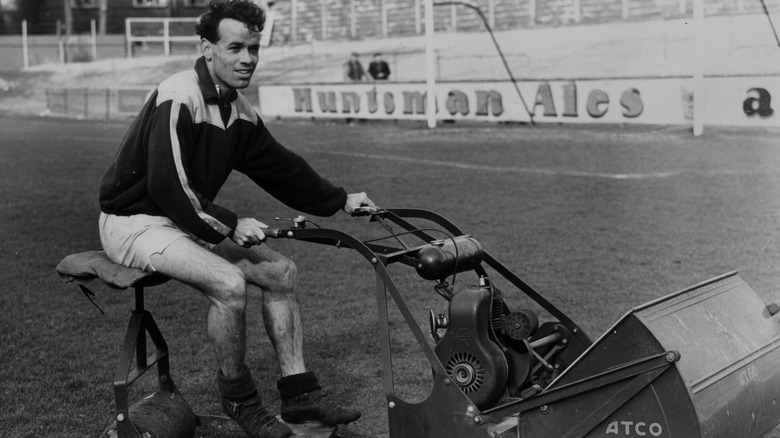
The early 1900s witnessed a whirlwind of innovations to the lawn mower and brought us very close to the mowers we use today. The first mower powered by gas, not steam, was invented in 1902. Once mowers were motorized, the first riding mower was developed. In the early 1920s, the first lawn tractors were debuted. The first gas-powered riding mowers were heavy and not very maneuverable, but they could cut up to four acres a day, so they were sold to large grounds like parks, cemeteries, and golf courses.
The 1930s saw the first electric mowers. They had to plug into an outlet and so had a very limited range. The same decade also saw the invention of the rotary motor. This was the first time a mower had a spinning blade that rotated on a vertical axis. Combined with a gasoline motor, this was essentially the same technology that is used today on lawns and grounds around the world. The 1950s introduced other mowing innovations like mulching blades to cut grass into tiny fragments, and the 1960s wowed lawn enthusiasts with the first zero-turn riding motors.
Robot and electric motors take over the 21st century, but old ways persist
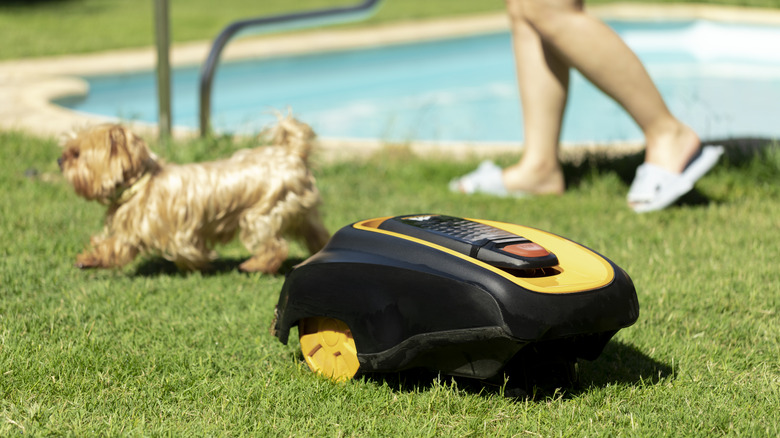
While electric options had been around since the Great Depression, it wasn't until the 1990s that battery-powered mowers were invented. Only in the 2000s, however, did these mowers start to make the switch from heavy lead-acid to lithium-ion batteries, becoming lighter and more practical. In 1995, the first commercially successful, solar-powered, robotic model, the Husqvarna Solar Mower, was released and paved the way for the future. Robot mowers are an eco-friendly option and have advanced in recent decades with GPS correction, 3D vision systems, obstacle detection, and advanced path-planning.
Today, all the technological improvements of the last two hundred years have come together. Over decades of innovation and improvements, lawn mowers of all types have become lighter, more ergonomic, safer, quieter, and more environmentally-friendly. There's a wide range of lightweight electric push mowers powered by lithium-ion batteries, like Ryobi's Brushless 20 in. Cordless Walk Behind Lawn Mower. There are also fully-autonomous options like EcoVacs Goat Lawn Mower. And reel push mowers, like this Scotts 20 in. Manual Walk Behind Reel Lawn Mower, are still a good choice for your grass. They provide a cleaner, sharper cut, which grass heals from faster and can mean less chance of disease.