

Move Over, Riding Lawn Mowers: There's An Easier, Eco-Friendly Option
We may receive a commission on purchases made from links.
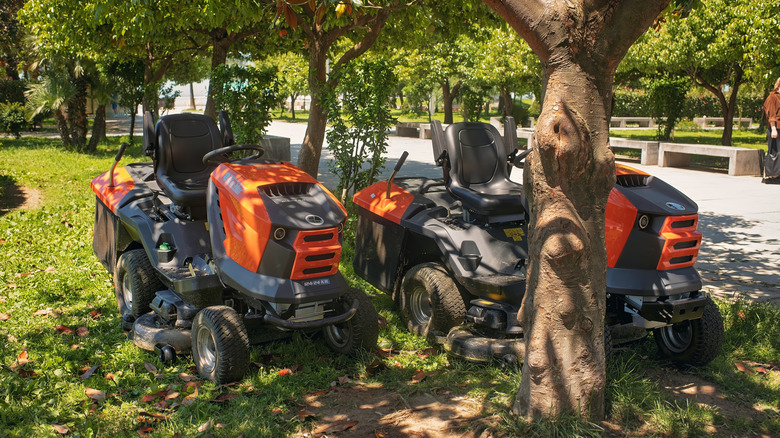
Take it from someone who actually owns a scythe: Robotic lawn mowers are where things are headed, and that's a good thing. Not for silly reasons like lawn striping and, well, grass in general, but for the good reasons: They're cheaper, easier, and more environmentally friendly. The sweet spot for robotic mowers seems to be in replacing riding mowers, not just push mowers, so that the answer to "Should I get an electric or gas mower?" is quickly becoming "go robotic instead."
Autonomous mowers have a lot going for them. They are quiet and energy-efficient and create no emissions. They require essentially no maintenance, and typically include a host of features (like smart navigation and daily micro-clipping passes). Less expensive robotic mowers have traditionally had fewer navigation options and features, like all-wheel drive, but once-cutting-edge (pun intended) features like Real-Time Kinematic (RTK) GPS correction, AI vision, and multi-zone path planning can now be had on sub-$1,000 models. Cheaper robotic mowers still tend to be designed for smaller lawns in the ⅛- to ¼-acre range. Robotic mowers average $1,697.93 at Home Depot, with both the cheapest ($648.99) and the most expensive ($3,373.95) garnering over 4 stars.
While you can still get a push mower far cheaper (the lowest Home Depot prices are $229 for a gas mower, $199 for a battery-powered mower, and $179 for a corded electric push mower), compared to riding mowers, the advantage of a robotic mower becomes notable: the average robotic mower is cheaper than the cheapest gas or battery-powered riding mowers at Lowes or Home Depot, and the most expensive robot mower is far less expensive than the priciest gas or battery-operated mowers.
Robotic mowers are easier to use
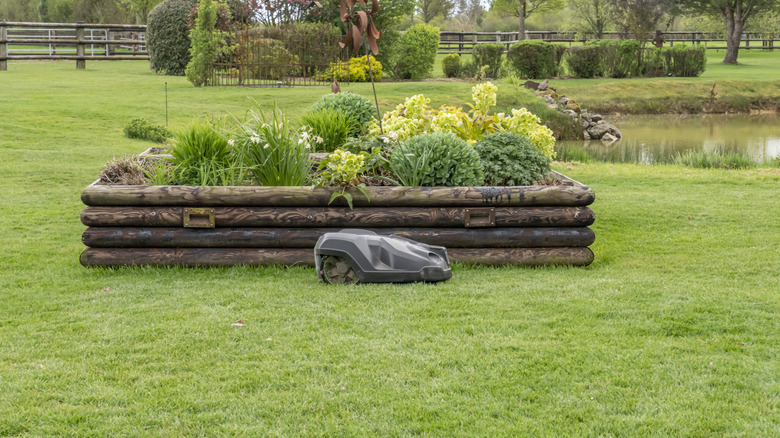
If money is no object for you, the pain of the actual mowing might be. Aside from the fact that you don't have to actually push or drive them, robotic mowers offer a constantly evolving roster of navigation, sensor, path-planning, safety control, and other features. Sensors, GPS, LiDAR, and AI-assisted vision make obstacle detection and path-planning accurate and are quickly replacing older buried boundary wire systems. RTK systems make GPS accurate down to the centimeter. Smart controls enable scheduling, zone adjustment, and remote monitoring, often by way of mobile apps.
The grass-cutting itself is steadily improving as well. Blade systems can be fine-tuned to trim your grass every day while cutting the clippings to lengths of 1 to 2 millimeters for better, less visible mulching. All-wheel drive and adaptive drive systems have drastically improved traction and made it possible for robotic mowers to tackle slopes one wouldn't attempt on a riding mower.
Run time is one place where gas-powered riding mowers might still seem to enjoy an advantage over battery-operated and robot models. But the gap is closing: Robotic mowers dock to recharge their lithium-ion batteries automatically, and improved battery tech makes it possible to mow more frequently and mow larger lawns with run times up to 2 hours, thereby improving one of the biggest downsides to electric lawn mowers. Some models even extend their battery run time by way of integrated solar panels that can generate enough extra juice to help with larger or more complex lawns. Overall, robotic mowers share the pros and address the cons of battery-powered lawn mowers, while outperforming gas riding mowers in most ways.
Robotic mowers are more eco-friendly

The efficiency difference between riding mowers and robotic mowers is even more dramatic. Older robotic mowers randomly covered the same ground over and over, but all that navigation wizardry has taken most of the randomness out of mower path-planning, increasing energy efficiency. Electric mowers are also far more efficient than gas engines ... 95% efficient versus 25% (via a 2019 Agriculture study), though you also have to consider the efficiency of your power grid. Electric motors generally rotate faster — getting a comparable blade speed and cut with a gas mower often requires full throttle ... and even more gas.
Robotic mowers also save energy because they are shockingly light compared to other mowers, using less energy to move the weight around. A robotic mower weighs between 15 and 40 pounds. By comparison, zero-turn mowers weigh 600 to 700 pounds, basic gas riding mowers weigh about 350 pounds, garden tractors around 1,000 pounds, and the average battery-powered riding mower at Home Depot weighs in at 416.17 pounds.
Of course, lithium batteries are saddled with high CO2 emissions from mining, extraction, and manufacturing operations that also require enormous amounts of water (about 500,000 liters per ton of lithium) and often leave the local watershed polluted. However, the U.S. electric grid is still cleaner than the fossil fuels used to power gas mowers, and in some states, such as California, a ban on small gasoline engines leaves only battery-powered alternatives. Your area might not be far behind.