

Ditch The Heavy Sanding: There's A Smarter Way To Smooth A Textured Ceiling
We may receive a commission on purchases made from links.
The popcorn ceiling might have been popular once — due to its supposed acoustic qualities, fast application, and ability to conceal imperfections in construction — but today, many see it as a dated eyesore or potential asbestos hazard. If you're one such homeowner, fear not, for you can always sand it (if it's asbestos free), cover the textured ceiling with tile, or skim-coat over it. Better still, if you're going the coating route and DIYing it, consider using a joint compound additive purporting to make the process easier and much quicker: Muddskip.
Skim coating is a straightforward DIY solution to disguise popcorn ceilings that entails covering the stippled texture with two or more thin layers of joint compound. But this requires complete drying between the coats — which can take hours to a full day for all-purpose, lightweight, and topping compound — and still much sanding or scraping. What Muddskip claims to do is shorten and ease the drywall mudding process by making the compound smoother and more workable.
You apply the Muddskip powder to joint compound with some water and mix it to a plaster-like consistency. The product enables wet-on-wet layering, meaning you're able to apply subsequent layers to your textured ceiling as soon as the previous one is just firm to the touch. More importantly, it simplifies creating a smooth surface. If you notice a dent, scratch, or other imperfection, you can just rehydrate the Muddskip-infused compound with a little water to soften it and smooth it with your trowel. You'll avoid sanding and generate much less dust, leaving you with less concern over breathing in harmful silica particles or dealing with an extensive cleanup job.
Using Muddskip to smooth a textured ceiling
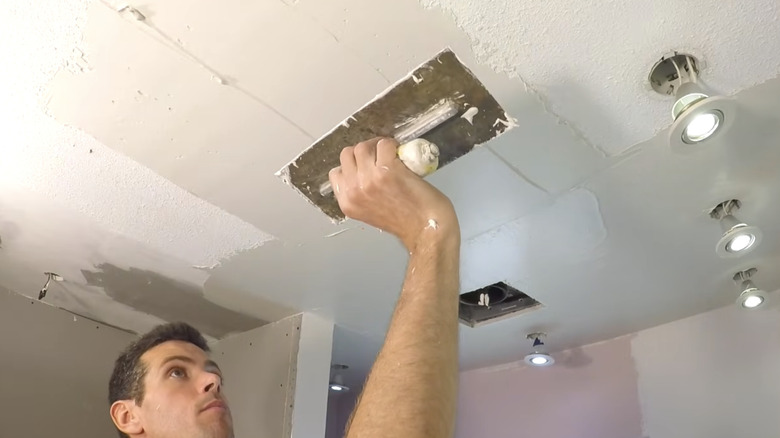
Follow Muddskip's package instructions for adding it to your drywall joint compound in the recommended ratios. Once it's fully mixed in, apply it to your textured ceiling. Instead of troweling it on, you can try taking a page from the creators behind RefreshHomeImprovements on YouTube to coat the ceiling faster: They used a drywall roller to apply each layer before troweling over to smooth it out. (FYI: A paint roller also does the trick.)
Reapplying before the previous layer fully dries typically pulls off some of the compound or causes bubbling, but a Muddskip mix supposedly layers on smoothly once the previous layer is dry to the touch (in 60 to 90 minutes, depending on humidity and climate). Then, it takes only a few sprays of water to soften the layer and smooth out a current layer with a blade or trowel. It firms up relatively quickly to allow another mud application, but you have 24 hours to rehydrate Muddskip after applying it if you want to smooth out any imperfections the dust-free way. Still, depending on your taping knife and trowel skills, your ceiling might require just a light sanding after you put on the finish layer.
Muddskip's innovative formulation has won it three International Builders' Show awards from the National Association of Home Builders, including the coveted Best in Show for 2026. But the ratings are a bit mixed so far. While it receives generally positive reviews for making mudding more DIYer friendly and reducing the sanding required, some users find it overly pricey or think the dry time doesn't significantly speed up the layering process.