

Concrete And Asphalt Patios Are Expensive: Try This Eco-Friendly Alternative Instead

If you're looking to build a patio in your yard but are on a tight budget, materials like concrete or asphalt are not going to be your best choices. Don't get us wrong, both are durable and attractive materials, but they are not what you'd call cheap. Concrete costs an average of $4 to $16 per square foot with professional installation, while asphalt hovers between $7 and $15. Since the average patio is between 200 and 300 square feet, these materials could end up costing thousands. That's why you should check out pea gravel as an affordable and eco-friendly alternative.
Pea gravel is a type of aggregate consisting of small stones with rounded edges and smooth surfaces that make them beautiful to look at and comfortable to walk on. Unlike asphalt and concrete, which require energy-intensive production, pea gravel is a natural stone that doesn't need to be mixed with anything in order to form a surface. Not only does it produce less carbon emissions than its counterparts, but it also allows for better water drainage and lasts for decades, making it a great gravel option for a long-lasting patio.
In terms of cost, Angi notes that pea gravel costs between $170 and $560 for a 200 square-foot project, or about $0.85 to $5 per square foot, including labor. This makes it significantly cheaper than asphalt and on par with the low end of concrete. However, you're going to continue to save even more money thanks to pea gravel's ease of installation.
Tips for installing pea gravel on your patio
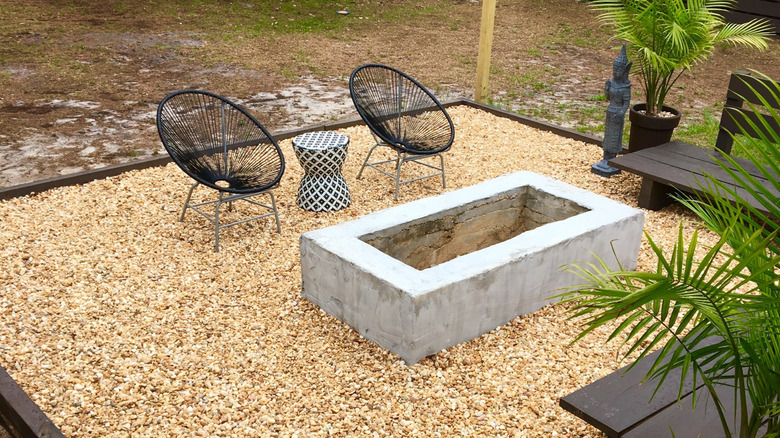
Although pea gravel comes in various sizes, ¼ inch is the most optimal size for patio areas. It doesn't shift as much as smaller sizes and isn't as rough on bare feet as larger ones. In terms of installation, pea gravel can easily be installed yourself if you have taken the time to ensure that the base it is being poured onto is level and properly compacted. Then, you can add landscape fabric to reduce weeds, lay your gravel down, and tamp it into place. If not properly set, pea gravel can become messy when walked over, which is one reason you might want to think twice before choosing a gravel patio. However, you could also install tall borders to keep the gravel from migrating beyond the patio.
As for styling, neither asphalt nor concrete can rival pea gravel. Most pea gravel comes in earthy tones like beige, gray, or brown, but there are also places that sell red, green, and yellow varieties if you want to create decorative accents. For a patio, a lighter-colored gravel can make the area feel more spacious, which can be a plus if you are working with a smaller square footage. Want your outdoor space to stand out even more? Accent the pea gravel with stepping stones, plants, or eye-catching edging, such as fieldstone.