

Don't Skip This Vintage Anchor Hocking Drinkware If You're Lucky To Find It
We may receive a commission on purchases made from links.
In the midst of the Great Depression, many glassmakers in the United States rolled out a more efficient, and more inexpensive, manner of producing glassware such as tumblers, plates, and cups and saucers. Mass-produced glass products kept these companies afloat, and were so inexpensive they came for free in oatmeal boxes. Flash forward nearly 100 years, and Depression glass has become a hot collector's item, with some pieces being more covetable than others. One example is Hocking Glass' Miss America tumblers. If you find authentic pieces in antique or thrift stores, don't pass them up.
While Miss America drinking glasses may have once sold for a few cents, today, they can go for much more, especially when part of a complete set. Interestingly enough, the price of the glassware goes up as the tumblers get smaller — a 10-ounce tumbler may be valued at around $35 while a Miss America juice tumbler, measuring 4 inches high, can go for $75 or more. Should you come across a drinking glass that still has the manufacturer's paper foil label on it — don't take it off. Glasses with stickers are worth more than glasses without.
Hocking Glass produced the original Miss America glassware from 1935 to 1938, shortly after it merged with Anchor Cap and Closure to form the Anchor Hocking Glass Company. But Depression-era glass designs proved to be so popular that reproductions were made beginning in the 1970s through today, which aren't nearly as valuable. When browsing for Miss America glassware, you need to know how to find authentic Depression era glass, rather than a reproduction.
There she is, Miss America
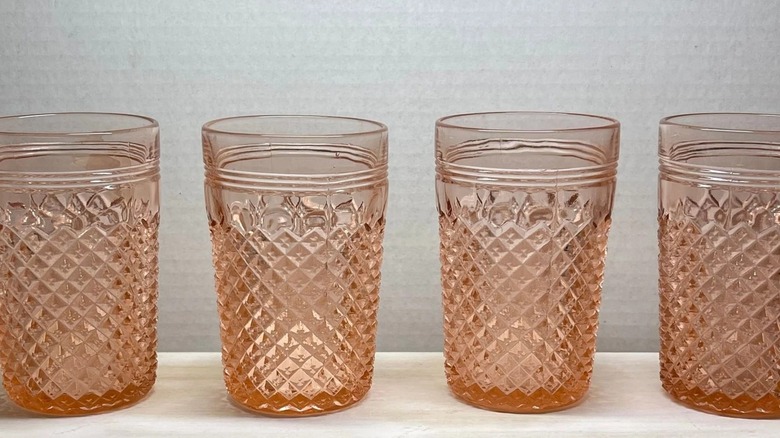
If you know what to look for, authentic Depression-era Miss America glassware is markedly different from the less-valuable modern reproductions, starting with the pattern. The original Miss America glassware featured what looked like small, four-sided pyramids, flattened as if the tops had been removed. Reproductions have a similar geometric pattern, but the cut is such that each nub looks like four smaller pyramids, and the pattern less sharp.
Pay attention to the construction of the glassware, too, as there are distinct differences between the originals and the reproductions. Miss America tumblers produced in the 1930s have four mold seams, especially visible near the rim of each glass. Early reproductions only have two seams, while later reproductions have four as well. A more surefire way to spot an original, 1930s tumbler is to look at the bottom: On authentic Depression-era tumblers, the bottom will be almost completely flat, with a visible mold seam. Meanwhile, 1970s reproductions have a 1/4 inch recess at the base and no seam.
Miss America tumblers are most commonly available in two colors, crystal clear and pink, with the pink versions commanding a higher price and generally being more popular. Other colors, such as green, ice blue, and Royal Ruby exist, but are much harder to find. While pink tumblers may sell for $35-$75 per, or around $100 to $300 for a complete set, ice blue tumblers can go for over $200 each. Whatever color you spot, these are perfect examples of glassware not to pass up should you come across them at a thrift store or vintage market.