

Black Widow Spider Webs Look Different: Here's How To Identify One In Your Home Or Yard
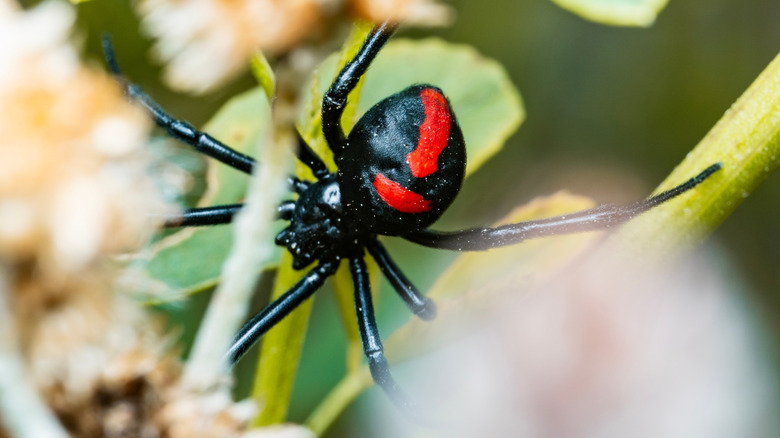
Of all the spider species found in the U.S., black widows arguably illicit the most fear among both arachnophobes and non-arachnophobes alike. While they typically avoid humans, they can bite upon contact and release toxic venom. Just as brown recluse spider webs look different, black widows also create a unique home. Many spiders create circular orb webs, but black widows spin irregularly-shaped tangle webs. These look just as they sound. Instead of being constructed in geometric patterns, they tend to appear as a jumbled bunch of threads with no particular shape. Aside from their distinctive shape, tangle webs are extremely sticky and strong.
There are five different black widow species throughout the continental U.S., and each one has some slight variations in where they build their webs. These cotton mesh-like webs can be identifiable based on their location in and outside of your home. While orb webs generally take up large elevated spaces in your yard or garden, black widow webs tend to be a little less conspicuous. Northern black widow species might still build their webs in elevated spots, but they are much smaller. Southern black widows, on the other hand, tend to spin their tangle webs near the ground, and especially in enclosed spaces. Black widows are most likely to hang out in their webs at night, but will hide in other spots during the day.
Where black widow spiders build webs, and what to do
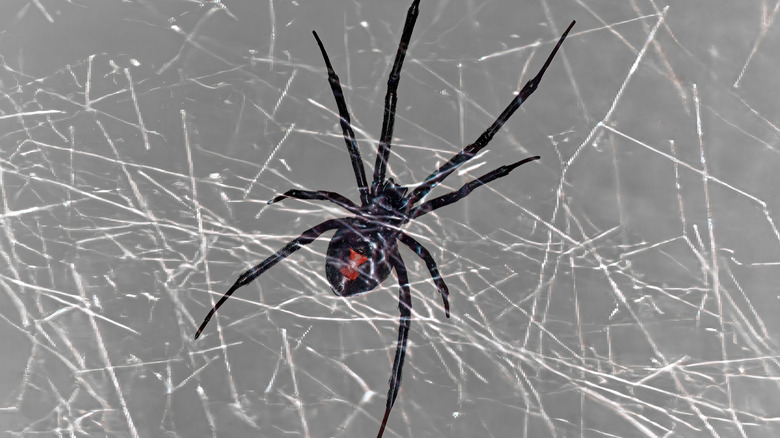
Just like you may find spiders in and around your home, it's possible to spot black widow webs in various spots in your yard and garden. These can include the tops of doorways and windows, by lighting and water meters, or within rock or woodpiles. It's even possible to find these tangle webs around a home's foundation. These spiders prefer setting up shop in dark spots, especially where they can catch prey in the form of insects and other arachnids, or they can safely nest. The same principle applies to the inside of your home, particularly in spaces with lighter foot traffic and where clutter might be more likely to build up. Examples include around dark corners inside a toolshed, garage, attic, or basement.
The challenge is that tangle webs are not exclusive to black widow spiders. It's possible for other spiders in and around your home to build tangle webs as well. So unless you actually spot a black widow and its notable red hourglass marking, there's no definitive way to confirm the web you're seeing belongs to one. With this in mind, it's generally best to leave any suspected black widows in your yard or home alone. Or contact a pest expert who can safely remove both the spiders and their webs. In the case of an abandoned tangle web, you may be able to cautiously vacuum it up. However, only do so while wearing heavy-duty work gloves and long sleeves to protect yourself if a spider is still lingering about. Never handle a web that's holding a live black widow spider.