

This Valuable Antique Dishware Brand Is A Thrift Store Find Worth Celebrating

We may receive a commission on purchases made from links.
Part of the joy of thrifting is the thrill of the hunt and the feeling you get when you stumble across a find you know is valuable, but the thrift store has given a bargain price. If you stumble across vintage or antique Rosenthal porcelain during a thrifting expedition, you've pretty much hit the jackpot. Depending on the year of production, the condition, the pattern, and the number of pieces, Rosenthal dinnerware can sell for thousands of dollars.
So, what's the deal with Rosenthal Porcelain? The company dates to 1879, when 17-year-old Philipp Rosenthal started a porcelain painting business in Selb, Germany. A little over a decade later, Rosenthal opened a porcelain factory and started producing his own dinnerware and figurines. From the start, the company had a good reputation, particularly when it came to how Rosenthal treated his employees.
In 1916, Rosenthal married his second wife, and named a dinnerware set after her, Maria. The set became one of the brand's bestselling lines and is still produced today. With the rise of the Nazi regime, Rosenthal had to leave the company in 1934, and died in 1937. After the war, his son, also named Philip, joined the company, paving the way for collaborations with well-known artists, including Andy Warhol and Raymond Loewy, who also designed one of Le Creuset's most valuable pieces. The company continues to partner with artists and designers, and most recently celebrated 30 years of collaboration with the house of Versace.
How to know if you've found Rosenthal dishware
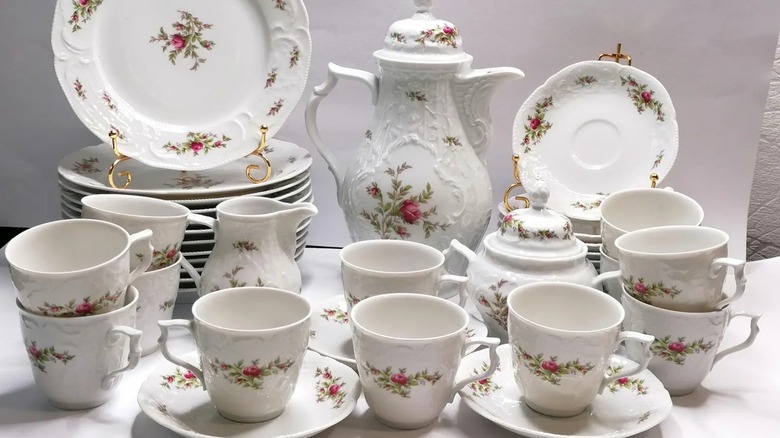
At first glance, vintage or antique Rosenthal dishes can look just like any other fine China set at the thrift store. You need to flip the plates or bowls over to get the scoop on their history. Every Rosenthal piece has a factory mark on its backside.
For example, the oldest pieces, dating from 1887 to 1891 will have a painter's palette and the initials "Ph.R.&Co" on the back. It's unlikely you'll find a piece with that mark, though, since it is so old and rare. Until 1906, the company's mark featured two crossed rods, a crown, and the initials R.&C. After 1907, the company switched to using a mark with the crown and rods and the full name written in cursive lettering. In later pieces, you may find just the crown mark, or a crown with an R or location below it. Determining the age of a piece based on the stamp gets a bit tricky at this point, as there are slight variations in the cursive and style from 1907 until the present date.
One thing to pay attention to is if the mark has the words "Classic Rose Collection" or "Classic." Starting in the 1970s, Rosenthal started to reissue some of its most popular patterns. While still attractive, the reissues aren't worth as much as the originals. Still, whether you come across an original Rosenthal from the early 20th century or a mid-century reissue, it's a valuable find you don't want to pass up at an estate sale or thrift store.