

Move Over, Pyrex: The California Dishware Brand Worth Hunting For At The Thrift Store
We may receive a commission on purchases made from links.
Are you feeling Pyrexed-out? Tired of trying to track down the in-demand, rare Pyrex dishes, like Blue Dianthus or Lucky in Love? Maybe it's time to add another vintage dishware brand to your thrift store list. Make way for Catalina Pottery, sometimes called Catalina Island Pottery. The brand's short history and the fragile material used to make its pieces mean it's highly sought after, hard-to-find, and incredibly valuable.
The story of Catalina Pottery dates to 1927, when William Wrigley, Jr., the owner of the Chicago Cubs, Wrigley gum, and much of Santa Catalina Island, created the Catalina Island Pottery and Tile Factory to give people living on the island jobs. Red clay was plentiful on the island, which the factory used to produce tile, bricks, and decorative pottery. The company began to hire talented artisans and ceramicists to make its distinctive products. Among them was Harold Johnson, who would later leave the company to work for antique dishware brand Bauer.
While the red clay Catalina Pottery used was distinctive, it wasn't very strong. In the early 1930s, the company began to add white clay to the mix, to strengthen its pottery. However, the cost of importing the white clay to the island proved to be steep. Eventually, in 1937, the entire company was sold and production moved off of Catalina Island. Gladding-McBean & Co, the company that bought Catalina Pottery, ceased production of its products in the 1940s. Although fragile and rare, many of the company's pieces survive. They can also be valuable; some larger pieces, like coffee urns and scalloped bowls, may be worth a few hundred dollars. Dishware sets are also sought after, with a rare pastel plate and espresso cup set from the 1930s going for close to $500.
Identifying Catalina Pottery at the thrift store
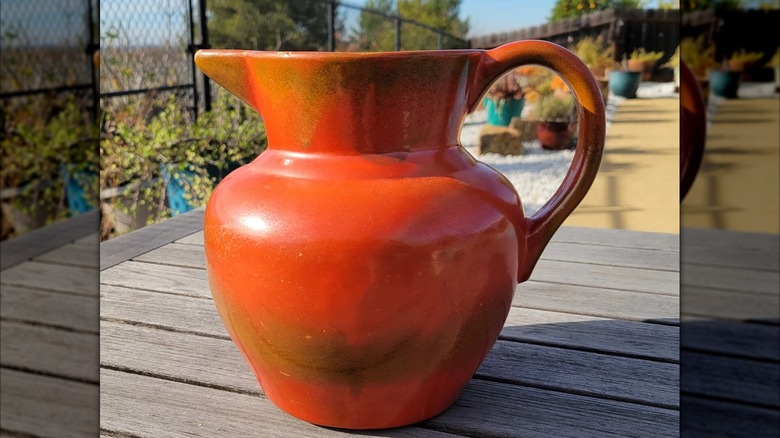
How much a piece of Catalina pottery is worth, and how easy it is to find at the thrift store, depends on a few things. One is when the pottery was made. Pieces created on Catalina Island, using only red clay, are considerably harder to find than those made off of the island, after the company was acquired. Since red clay is so fragile, it's likely that any pre-1932 pieces you find will have little chips or marks in them. Those chips don't really diminish the value of the piece.
Another way to identify a piece of Catalina Pottery is to look at the stamp or mark on the back. Pieces made before the acquisition will have "Catalina" or similar embedded in the clay itself. Pieces made once the company was purchased by Gladding-McBean & Co will have an inked stamp on the back, rather than engraved. It will likely read "Made in USA" in addition to the brand's name.
While the stamp or marking is the most sure-fire way to tell if what you're holding is a piece of Catalina Pottery, you may also be able to identify a piece by the colorful glaze. Just as the clay used originated on the island, many of the glazes were made from minerals sourced from Catalina Island. Colors had names such as "Descanso Green," "Toyon Red," and "Catalina Blue." Whatever the color, it's another piece of valuable vintage pottery you'll be thrilled to find at a thrift store.