

The Blue Jay Look-Alike You Don't Want To See In Your Yard
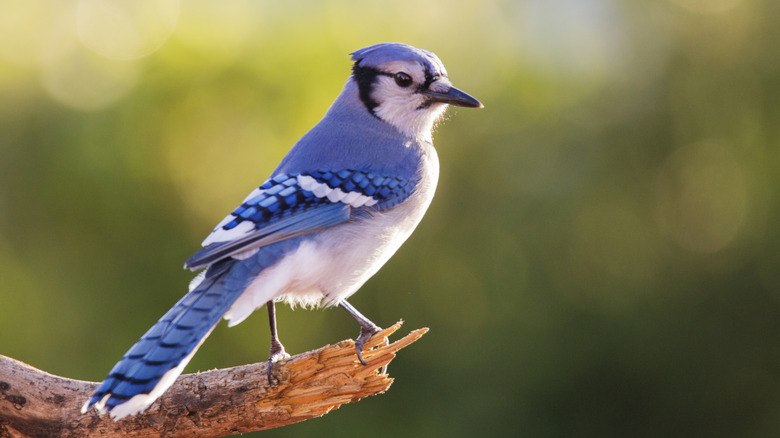
Familiar crested Blue Jays (Cyanocitta cristata) are common east of the Rockies and in the Northwest, announcing themselves with their piercing jayy-jayy call. In spite of its noisy nature, the blue jay is usually welcome in most backyards, but the same can't be said for the scrub-jay (or scrub jay). Scrub-jays are aggressively territorial and known for scaring off other birds, so they've developed a poor reputation and are among the birds people don't like to see flying around their yard.
Two species of scrub-jay — the California scrub-jay (Aphelocoma californica) and Woodhouse's scrub-jay (Aphelocoma woodhouseii) — range west of the Rockies, and another — the Florida scrub-jay (Aphelocoma coerulescens) — lives in Florida. Like blue jays, scrub-jays are members of the family Corvidae that includes crows, ravens, and magpies, and despite the name, they aren't actually jays. They don't have crests on their heads, and they make a different call, which is more of a weeping sound with an upswing at the end.
Scrub-jays are bullies to smaller birds like crowned sparrows, which will stay several feet away when one is present. It's not just birds they harass; California scrub-jays have also mobbed cats, squirrels, and even bobcats. Their aggressive tactics are a survival strategy that extends to defending their own nests. When brood parasites like cowbirds lay eggs there in the hopes of having their young overtake the fledgling scrub-jays, adults can quickly identify these rogue eggs and throw them out. However, scrub-jays are also known to attack the eggs of smaller birds.
If you don't want scrub-jays coming around, don't feed them
To be sure, not everyone dislikes scrub jays, but some of those that do also find them particularly frustrating. A Reddit user complained in a three-year-old post how swarms of Woodhouse's scrub jays would sit in the trees and watch for them to set out bird seed, then swoop down in gangs, chase away smaller birds like goldfinches, chickadees, and doves, and eat everything in about 10 minutes. The user estimated that the birds got almost all of the food they had set out, eating some and taking more to cache.
There were two helpful suggestions on the resulting thread. The first was to simply take the bird feeder away until the scrub jays give up and start looking for food elsewhere. During this time, you'll have reduced traffic from other birds attracted to the bird feeder, and the strategy may not work, given the watchfulness and persistence of the scrub jays. And even if they do stop coming, they'll probably return soon after they discover food once again available.
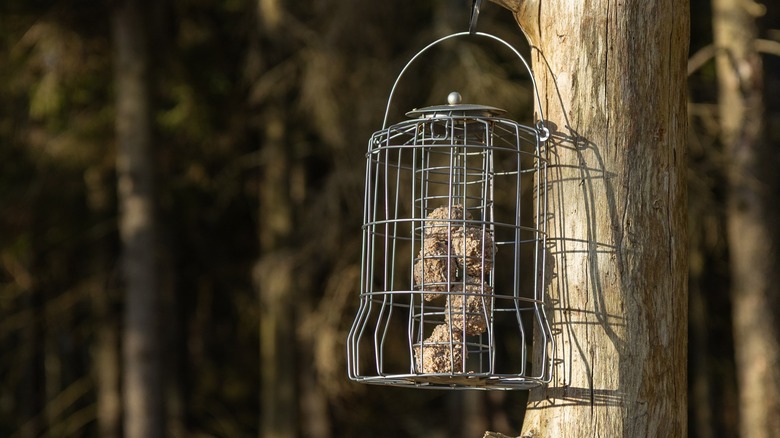
The second suggestion was to use a caged bird feeder. Compared to other birds, scrub jays are fairly large, and it isn't difficult to find a cage with a mesh size that allows the smaller birds to enter while keeping them out. This is one way to keep squirrels out of your bird feeder, and there's no reason why it wouldn't work for scrub jays.