

Not Concrete, Not Gravel: The Eco-Friendly Patio Alternative Gaining Popularity

A backyard patio is a gathering space for friends, a family dining area next to the grill or pool, or a quiet hangout for coffee in the morning or a glass of wine after work. There are a lot of fun patio surfacing trends to consider when contemplating an attractive hardscape for your backyard, from concrete and stone to artificial turf or gravel. But if you are interested in an eco-friendly material that looks good, is easy to install, and holds up to outdoor fun, consider composite pavers.
A composite paver is an engineered landscaping brick made up primarily of recycled products like rubber tires. These pavers weigh one-third as much as concrete, making them a lightweight choice that is easy to work with. Composite pavers from most manufacturers meet the U.S. Green Building Council's standards for LEED certification, meaning they are considered a sustainable building material. They look pretty, too, with a variety of patterns and colors to choose from for a unique patio design. These pavers are a great choice around pools and hot tubs because they excel at providing a safe and slip-free surface while being easy on bare feet. They are also durable and can hold up to a lot of wear and tear, even being considered an eco-friendly material for your driveway. For a patio space, composite pavers resist stains better than concrete, which is a great feature where eating and drinking might be a main activity. Once in place, composite pavers are durable and maintenance-free, unlike other patio materials which might need resealing or repair over time.
Some pros and cons of composite pavers
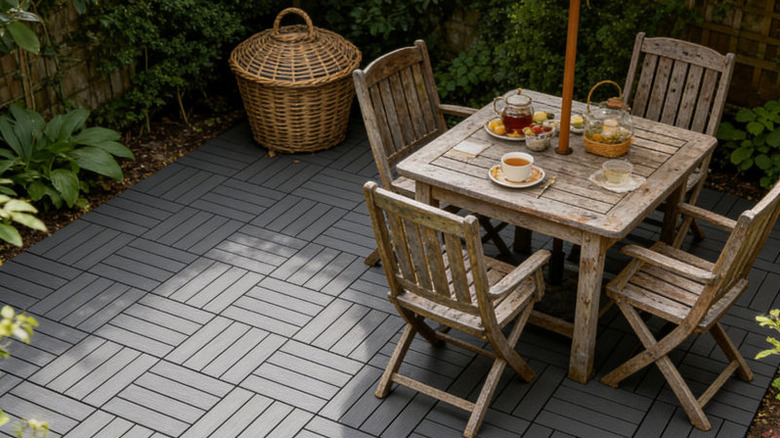
Beyond being an eco-friendly patio alternative that keeps rubber and plastics out of the landfill, composite pavers can be a budget-friendly choice if you DIY your installation. Putting in a patio can cost thousands of dollars, and the cost of the material is only part of the equation. Composite pavers aren't necessarily cheaper than other pavers like concrete or brick, but the savings can come in installation. YouTuber Mr. Build It shows how installing these pavers can be a straightforward DIY project, far less labor-intensive than working with heavy stone or concrete. Composite pavers often come with an underlying grid system, making laying out your pattern a relatively simple process (Mr. Build It compares it to building with Legos).
Despite these advantages, there are places where composite pavers may not be ideal. Although the use of recycled tires in landscaping is considered generally safe, the "crumb" form of this material continues to be under government review for potential health impacts. If you have a stream or waterway near your patio, or you are growing veggies nearby, you may not want to choose a recycled rubber product, which can leach toxins that can harm water quality and be taken up by your garden. Heat is also an issue. If you have a fire pit envisioned for your patio, composite pavers may not be your best choice, as flying embers can melt the rubber material (although it is less combustible than a wood deck). Composite pavers can also get hot in direct sunlight, so choose a lighter color if your patio lacks shade.