

The Scrap Wood Trick You Need Before Sharpening Your Lawn Mower Blades
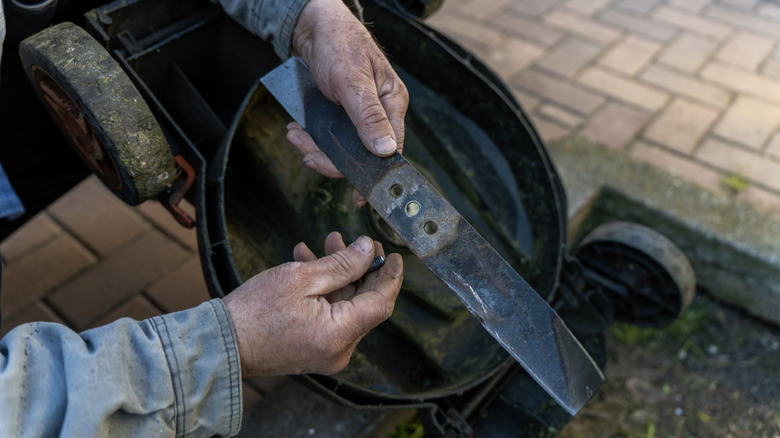
Plagued with torn grass blades, an uneven lawn, and excess mower vibrations? You probably waited a little too long to sharpen your mower blade. This is a basic part of lawn mower tune-up and maintenance, albeit one that's easy to forget in the throes of the mowing season. Sharpening blades isn't difficult, and it's an essential task to prolong the life of your mowing equipment, but it can also be dangerous if you rush — especially when you try to remove a spinning blade. One easy solution to this? A piece of wood! When positioned under the mower deck, a 2x4 stabilizes the blade so you can remove it from the machine safely and get on to the next step: implementing the safest way to sharpen lawn mower blades.
Unscrewing the blade can be a challenging job: When you start loosening the nut that holds it in place, the blade will often start spinning, which makes it difficult to remove. It's also dangerous, because, even if the blade needs to be sharpened, it can still cut you. Plus, it's frustrating to wrestle with an uncooperative blade just to complete a basic care task. You can buy a blade locking tool to help out with this problem, but that's just one more gadget that you're spending money on. Scrap wood makes for an effective and inexpensive alternative.
Secure the mower blade for removal with a 2x4
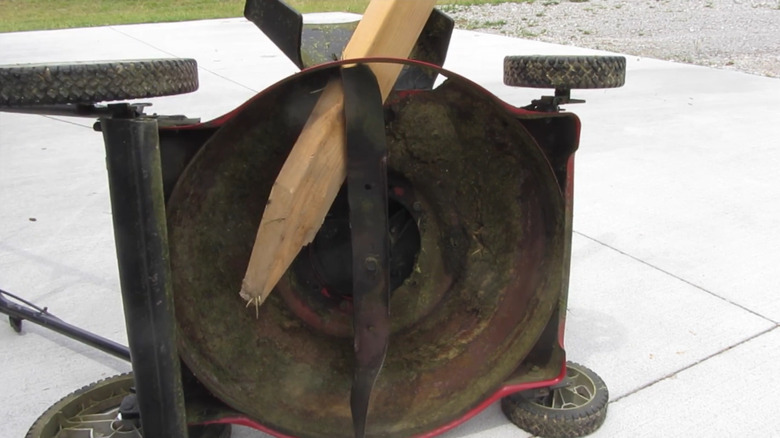
Don't grab just any wood for this blade sharpening tip. The board needs to be substantial enough to lock the blade in place without being too big — a 2x4 is the ideal size. Before you use this method, prep your mower like normal, whether you're sharpening your mower blades with common tools or specialty gadgets. That includes running the gas out of the machine and disconnecting the spark plug to keep the mower from turning on. Then, turn it on its side.
Wedge the wood underneath the mower between the deck and the blade. You can push it through the grass chute opening at an angle and rotate the blade into the wood, or place it at an angle inside the deck near the bottom, with the lower blade tip pushed into the wood. You want it to stop the blade from moving, so you can apply the necessary pressure to remove the fastener. Once you loosen and remove the blade, the wood might drop due to the loss of tension against it.
You can also use your 2x4 when you connect the blade again. Position the wood on the opposite side of the blade this time, since you'll be rotating the bolt and nut the other way to tighten it. As you turn the wrench, the blade will stop at the wood board, allowing you to secure it adequately.