

Not Mulch Or Gravel: The Better Way To Prevent Weeds & Help Soil Thrive
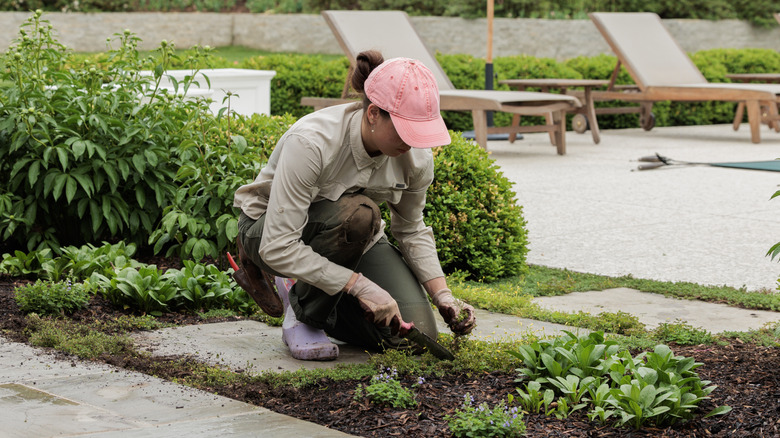
Death, taxes, and weed growth. These are some challenges that mere humans often find insurmountable. (Or perhaps insufferable.) Unwanted weeds in our gardens and landscaping may not be the most serious problem, but they may be one of the most vexing. One product that can help us regain our power over unwanted greenery is slate chips (slate chippings). These small chunks of metamorphic rock are gaining popularity in our backyard campaigns to limit weed growth. The gray/green/blue hue of the chips are attractive and environmentally friendly, and when applied in a layer 2-inches thick will create a water permeable weed barrier. But does it have advantages over more traditional hardwood mulch or gravel?
Questions like that can be hard to answer, so let's start out with what slate chips bring to the task and then compare the others. As it is fractured rock, once in place it will not break down into the soil, disappearing like wood mulch from one season to the next. A neutral rock, slate chippings have benefits for soil: It will not change its PH, and will help regulate soil temperatures and control water runoff.
Although slate chippings will resist weed growth, without the use of landscape fabric, it will not likely stop all weed growth. (But the weeds that persist will not be robust.) Organic mulch will not persist and will merge into the soil, adding nutrients as it does. But slate is inorganic and will not enrich the soil in the same way. Like slate, organic mulch also needs landscape cloth to eliminate weed growth.
Using slate chippings as mulch
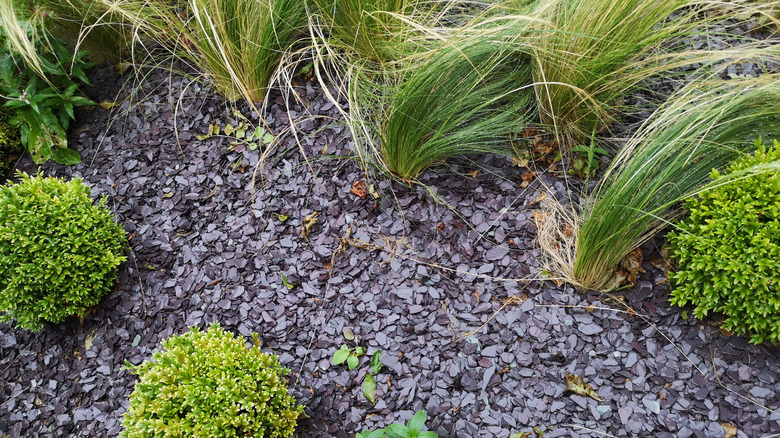
Occasionally you'll hear folks describe slate chippings as "mulch," but that is truly stretching the definition. But if your primary reason for applying an organic traditional mulch is weed control, then conflating the two is understandable. Another reason that folks use traditional mulch is the aesthetics landscape mulch provides, presenting a uniform surface that accents and draws attention to a planting or a boarder. This is a task that slate chips are exceptionally well suited for. While each chip is irregularly shaped, applied in a layer they provide a uniform appearance in lovely, muted hues. As mentioned, the chips stick around season after season as rock does not break down like organic mulch. The chips' irregular shape, caused by slate literally fracturing as it's being mined, means that it is not a great product for pathways and other foot-traffic areas. It can be uncomfortable on bare feet.
As with installing other rock-based products (gravel, flag stones, pavers), preparing the surface properly is the key to your DIY success. A flat, compacted surface covered with landscape cloth or membrane is recommended. After that, a 2-inch layer of slate chippings will provide good coverage and water control.