

What Happens If You Water Plants At Night?
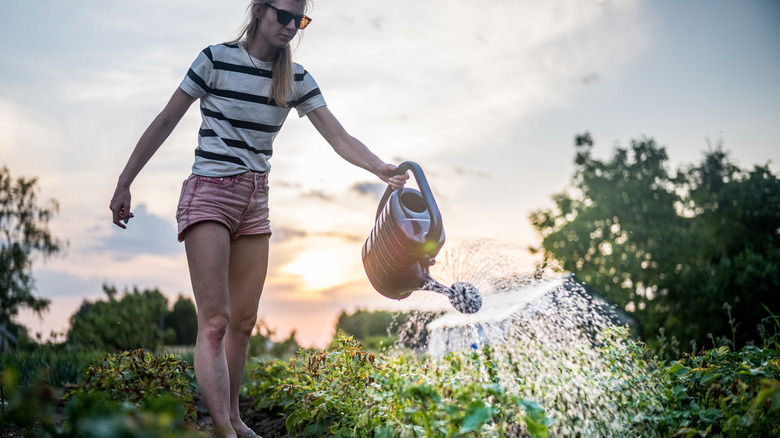
Have you ever wondered what happens if you water your plants at night? It seems like a good time to do it. The sun isn't shining, and temperatures are generally cooler, so the water won't evaporate quickly, right? Not so much. In an exclusive interview with Hunker, Dr. Manjot Sidhu, Ornamental Horticulture Specialist at the University of Maine Extension, explains why night watering isn't such a good idea.
"Watering plants at night is generally not advised because it wets the foliage and soil and creates a favorable environment for development of fungal and bacterial diseases like mildews, blights or spots. There is not enough sunlight or air movement to evaporate the water at night. Additionally, wet and cool soil may reduce oxygen (create hypoxia-like conditions) in the plant root zone and may lead to root rots," Sidhu explains.
While this advice primarily concerns outdoor plants, Sidhu points out that despite being in a more controlled environment, indoor houseplants shouldn't be watered at night either. "Night time watering saturates the soil, leading to anaerobic conditions that may cause root rot," she explains. However, it's also important to keep an eye on your houseplants to see if the top layer of soil is dry. If this is the case, watering at night can keep your indoor plants from dying or developing yellow leaves from under-watering. Still, Sidhu explains that you ideally want to be watering all your plants far earlier in the day.
How and when to water your plants for optimal health
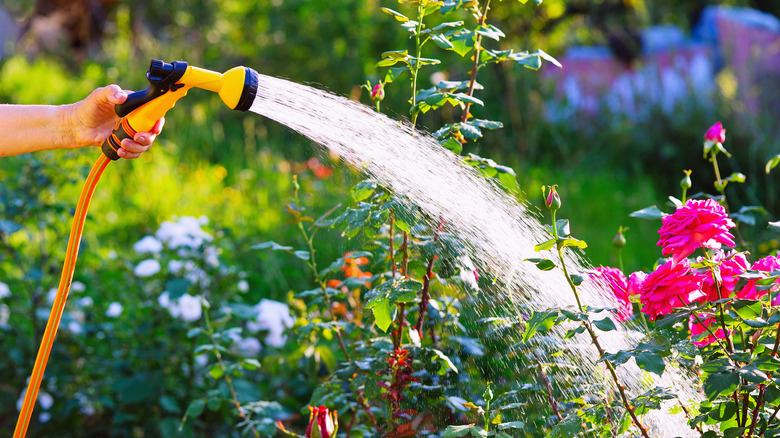
In her exclusive interview with Hunker, the University of Maine Extension horticulture expert Dr. Manjot Sidhu says that the ideal time of day to water your lawn and plants is in the morning. Water plants "before 9 a.m., when ambient temperatures are between 60-80 [degrees Fahrenheit]," Sidhu says. "Morning watering allows water to settle and get soaked into soil and excess is evaporated as temperature rises during the day."
Watering in the middle of the day is not ideal because the water will evaporate too quickly. However, Sidhu notes that if plants are looking wilted, you should definitely provide them with additional watering. She also mentions that "newly planted plants, shallow rooted plants, annual bedding plants, moisture-loving ornamentals, and plants in sandy soil may need frequent irrigation, while mature plants, succulents, perennials, natives and plants in heavy soil may need less water."
As for practices that homeowners can implement to make sure that their watering does not encourage pests and diseases, Sidhu says basic tricks like proper plant spacing, not watering the foliage, and the use of drip irrigation systems for deeper watering will work well. She also recommends choosing an organic mulch and layering it 2 to 3 inches thick to make sure that moisture is being retained in your garden's soil.