

The Distinctive 1980s House Style You Rarely See Built Today
From bright colors and bold patterns to big hair, the '80s aesthetic was singularly ostentatious. The same holds true for many of the decade's architectural trends, including the unique 1980s contemporary angular house style. From the outside, these domiciles are defined by eye-catching angles, slopes, asymmetrical rooflines, and an abundance of windows. They're brimming with personality, given the variance in design. Step inside and you'll likely find high ceilings, loads of natural light, and an open floor plan to fit the items only '80s kids will remember, from boom boxes to console TVs. But, due to their impracticality, we don't see these homes being built today.
The mismatched exterior elements of a contemporary angular house are characteristic of postmodern architecture, which originated in the '60s and expanded throughout the '70s and '80s. Postmodern architecture was seen as an abrupt departure from, and a dismissal of, the benign practicality of modernist architecture earlier in the century, focusing instead on complexity and individuality. Some of the most famous postmodern buildings include the Guggenheim Museum in Bilbao, Spain, and Tokyo's M2 Building. Thanks to contemporary angular design, everyday homeowners could enjoy a small piece of the postmodern wave as well, especially since many retro '80s home features have become trendy again.
Why aren't contemporary angular homes as common today?
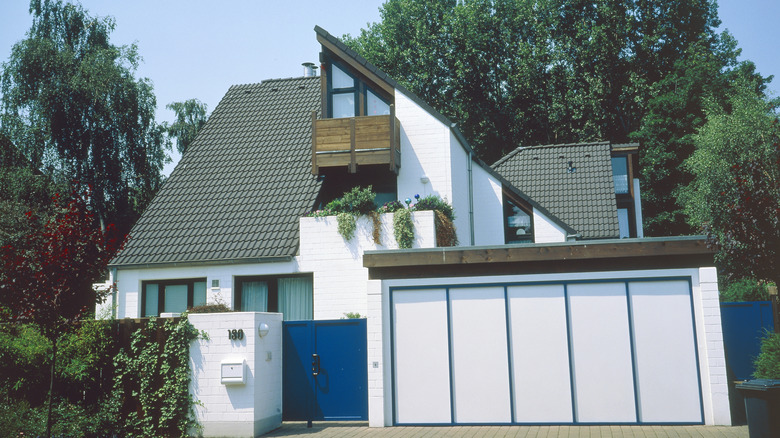
Like shoulder pads and parachute pants, some trends fade away. 1980s contemporary houses didn't have the staying power of, say, an American craftsman, so we don't see quite as many of these angular oddities today. Renowned postmodern architect Frank Gehry, designer of the Guggenheim Museum in Bilbao, said (via ArchEyes), "Architecture should speak of its time and place but yearn for timelessness." While '80s contemporary angular houses certainly fulfill the first part, showcasing many of the design traits that were stitched into the decade, they're lacking in the timelessness department. Their unusual look, both inside and out, was likely a factor in this.
However, there are pragmatic reasons for the decline as well. For starters, the expansive footprint coupled with tons of large windows makes these homes less energy efficient. Secondly, they don't fit the cookie-cutter, cost-effective template of modern spec houses, which account for roughly half of new-home sales today. Even though many retro design trends are making a comeback, it's unclear if contemporary angular houses will follow suit. They tend to be incongruous with modern home design, which emphasizes minimalism, simple lines, and energy efficiency. Consider yourself lucky if you own one of these distinctive houses emblematic of the 1980s.