

The Valuable Vintage Vase You Should Never Overlook At An Estate Sale Or Thrift Store
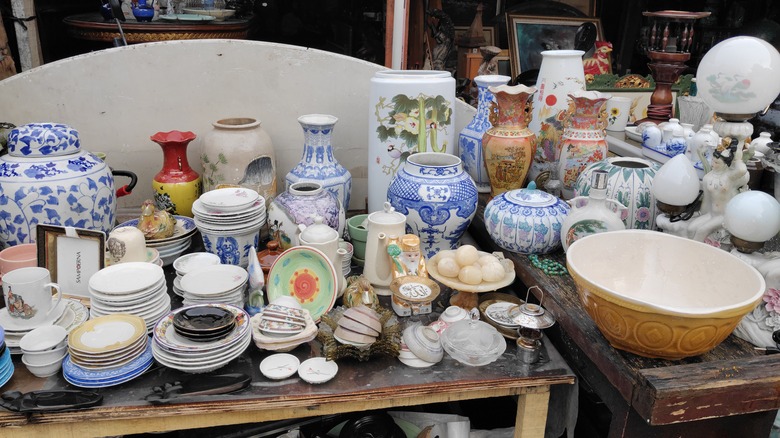
Here's the thing about shopping estate sales and thrift stores: You never know what treasures you might find — but, there's a caveat. You actually have to know what you're looking at in order to understand why it's a treasure. It can be very easy to overlook something like jadeite glassware without understanding the true value of what you've encountered. This is especially true with vintage cloisonné and champlevé vases.
TikToker @emmiethrifts recently came across one of these highly decorative and colorful vases on the cheap, and was surprised to find out just how valuable they really are. At their core, cloisonné and champlevé are artistic methods that bring enamel and metal together into tremendously detailed pieces. Both are techniques that have been used for centuries, and if you're a keen-eyed thrifter, you'll be thrilled to come across one at an estate sale or thrift store.
Serious collectors will pay hundreds to thousands of dollars for good cloisonné and champlevé vases at auction. Chinese Ming Dynasty and Japanese Meiji Era vases are the most coveted, as their craftsmanship and artistry are unmatched. Just to give you an idea of the true value of these vases, a Chinese cloisonné vase sold at auction in 2017 for $812,000. So, while the estate sale agents and thrifters might not necessarily know what they've got, you'll certainly know that these are one of the valuable collectibles you shouldn't overlook at an estate sale.
The difference between cloisonné and champlevé
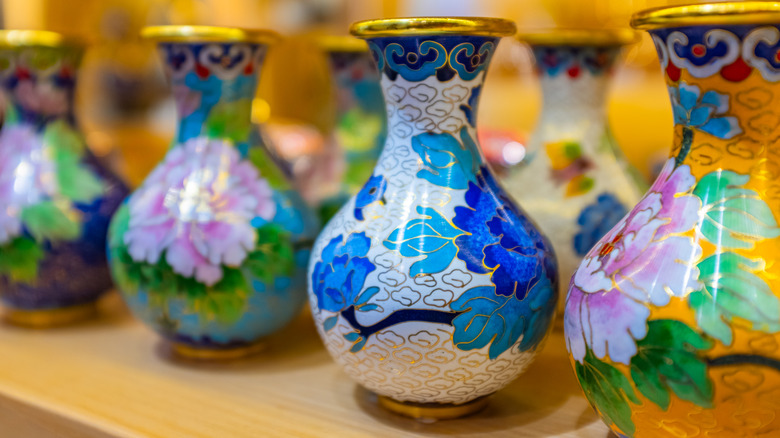
It can be very easy to confuse cloisonné and champlevé. From a distance, they might look the same; however, closer examination of cloisonné and champlevé will reveal details that make each art form distinctive. The cloisonné technique uses small, flat wire to create a pattern over a metal surface. Different colored enamels fill the cells made by the wires before being baked in a kiln. The end result is a vase with intricate patterns that still show the metal dividing lines, which are traditionally plated in gold to prevent tarnishing.
Champlevé requires a thicker metal, as the pattern is made by etching directly into the metal surface, as opposed to being traced with wire. The relief that is created is then filled with different colored enamels. The patterns of both cloisonné and champlevé can be equally intricate, which can make them difficult to differentiate at a distance. Up close, you will find that cloisonné vases may have slight ridges to them, while champlevé is nice and smooth. Also, a cloisonné vase is going to be much lighter in terms of weight because this technique uses thinner metal, whereas champlevé requires thicker metal, owing to the fact that the pattern is etched directly into the surface. By picking up the vase, you should be able to tell the difference, thanks to the weight and surface texture. Either one of these types of vases could easily become the best thrift shop find of the year.