

Can You Use A Leaf Blower To Remove Snow From Your Driveway?
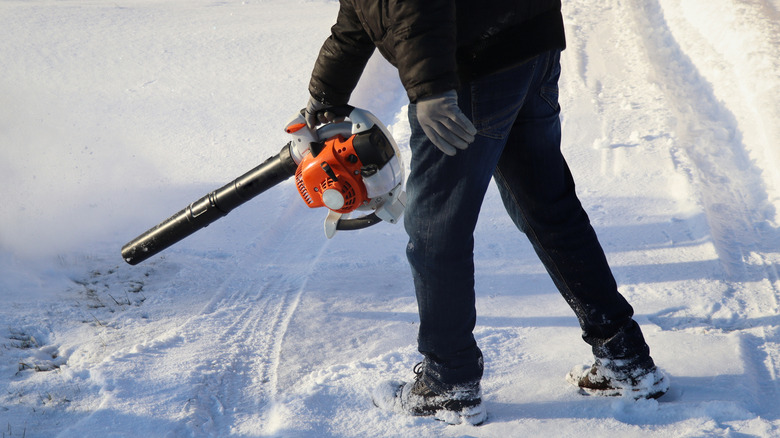
Every winter, people are always looking to ditch their shovels for easier alternatives. For certain, laying a heavy-duty tarp over your car or walkway is an effective alternative to snow shoveling. But what happens when you use a tool that was never designed to remove snow? Well, for many years now, people have been using leaf blowers to clear everything from driveways and cars to sidewalks and porch steps. It seems like an effective solution, but is it actually a good idea? At face value, the answer is: yes, using a leaf blower is good for removing snow. However, as we look a little deeper into using a leaf blower for snow removal, it is not as convenient as it seems.
Essentially, the machine performs the same task that it did in the fall, only instead of blowing leaves into a pile, you're blowing snow. People have posted all over social media showing just how easy it is to use a leaf blower to remove snow. They simply strap on, or plug in, the machine, aim it at the snow, and blow it away. It's relatively straightforward — but not only will a leaf blower only work when removing a specific type of snow, but having it out in that cold, snowy weather could actually have adverse effects on the machine itself.
A leaf blower is only good for one kind of snow
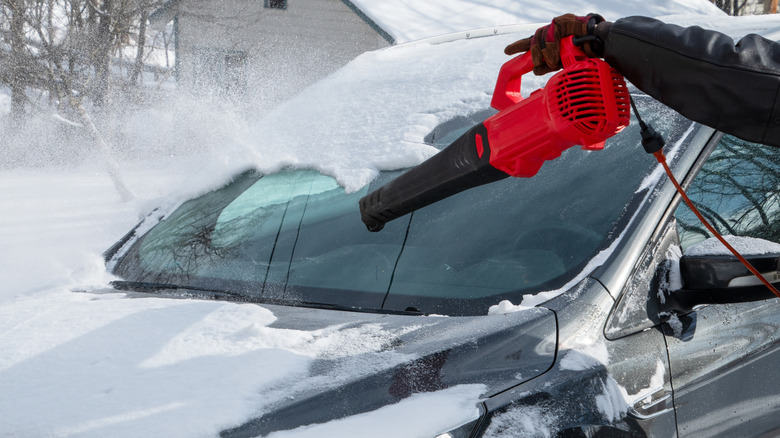
It shouldn't be surprising to find that a leaf blower is only effective at removing light and fluffy snow. Even then, it only works when a few inches of very light snow have fallen. This is because leaf blowers are designed to blow leaves, which are very lightweight.
What leaf blowers cannot do is remove any heavy, wet, or built-up snow. That's a job for a snow blower, a machine designed specifically for handling larger snow loads. Even if you have a high-powered leaf blower, it isn't going to do much of anything when it comes to removing heavier snow. And while we will admit that a leaf blower can often manage to get broken chunks of ice out of hard-to-reach spots, it can still be potentially dangerous to have shards of ice being blown around in the air.
Plus, there is the size of your area to take into account. Sure, if only an inch or two of snow has fallen and you have a short driveway, by all means use your leaf blower; it can likely make quick work of the problem. However, it really won't work for longer driveways. For that, you're still best with a snowblower, a trusty shovel, or even a riding lawn mower that's been outfitted with a plow kit.
Cold and snow can ruin your leaf blower's engine
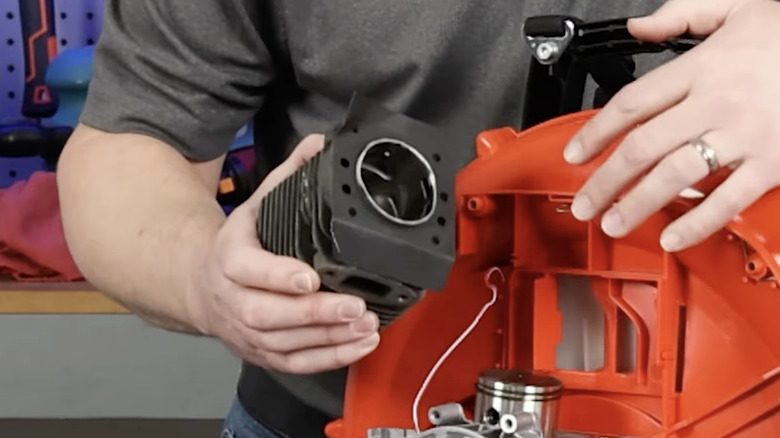
Another reason why it's not a great idea to use a leaf blower to remove snow is what winter can do to the engine. Leaf blowers are small-engined machines with relatively little horsepower built for a specific purpose. Those engines are air-cooled, which means that air is forced over the engine with fans to keep it from overheating.
As a result, when you work the engine in cold weather, the cold air being pushed over the engine causes the metal in the compression system to shrink. This means that the piston will be rubbing against the cylinder walls. When you try to use it in the summer and the metal expands, you will lose compression, and the engine may stop running even after it has warmed up. You also have the issue of fuel lines shrinking in the cold, which could cause leaks.
While they are constructed differently, you can also run into issues with electrically powered leaf blowers. If snow gets inside the machine, it can cause ice damage, corroding the electrical components and leaving you with a machine that doesn't work. So, overall, while it can be used in a pinch for lighter loads of snow, it's really not a great idea to use a leaf blower to remove snow in most cases. Instead, get yourself a machine that's built for the task and follow our tips for snow blowing beginners.