

Neither Vinegar Nor Baking Soda: The Trick People Are Using To Clear Clogged Drains

Your kitchen drain has stopped flowing. Your quick Internet search tells you why you may want to reconsider using baking soda and vinegar; however, it may suggest an even easier solution: salt and boiling hot water. This combination may seem harmless, but it's actually not a good idea, especially if you live in a modern house. Why? While there is nothing wrong with the salt, it's the boiling water that may cause the problem.
In most of our homes, the pipes under our sinks are made of polyvinyl chloride (PVC), a sturdy and easy-to-work-with material. But a curious fact about PVC is that it is only designed to handle water temperatures up to 140 degrees Fahrenheit; boiling water is 212 degrees Fahrenheit at sea level, so you can see the problem. While not recommended, pouring a bit of boiling water down a free-flowing sink drain from time to time will not likely cause any problems. It'll move through quickly, and the temperature will drop once it's past. But if you have a clogged or even a slow-moving drain, boiling water will be trapped, quickly exceeding its temperature limits. The overheated PVC pipes can sag and distort, and their joints may even come open.
Better ways to clear drains
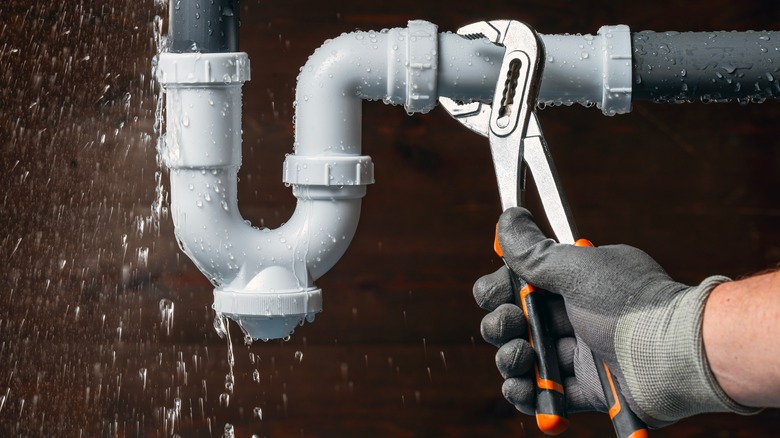
So with boiling water out as a solution, plugged drains remain a problem. Thankfully, there are several ways to address the clog that will not harm your plumbing. There are, of course, commercially available products designed for the problem, and if the clog is in the curved section of the pipe under your sink (often called the P-trap), you can take that apart and remove the clog manually (potentially gross, but effective).
One chemical that might help includes hydrogen peroxide; it will break down the organic components of the clog. Additionally, we mentioned above, vinegar and baking soda are often recommended to be used in tandem to clear clogged drains, but using either one individually will likely provide better results. Baking soda is very alkaline, and vinegar is acidic. Either one will break down a greasy clog, as grease sits in the middle of the pH scale. Use them together, however, and you get a chemical reaction that will neutralize their pH and render them just salty water. It is true, however, that the forces of that chemical reaction, as it releases carbon dioxide, may force the clog free. Instead, put either baking soda or vinegar in the sink, allow it to work for an hour or so, and follow with hot (not boiling!) water. Using them sequentially can be effective, too.