

Never Pass Up This Vintage Glass At Estate Sales - It's More Valuable Than You Think
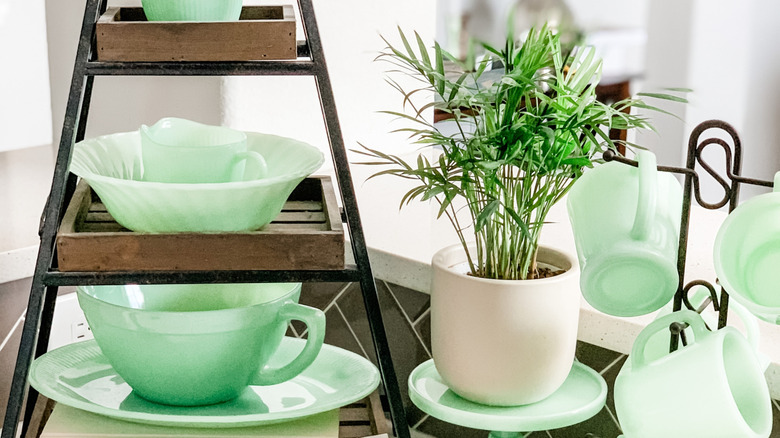
Estate sales offer vintage enthusiasts some of the best opportunities to find quality antique items at affordable prices. Secondhand glassware can be particularly prized, especially if it is in good condition. A good glassware set can add exceptional visual and practical value to your home, and Fire King jadeite is one type that you should absolutely never pass up. Hunker spoke exclusively with award-winning media personality and antiques appraiser Dr. Lori Verderame Ph.D, who explained the unique history of jadeite, what collectors should look for, and how it could be more valuable than you might think.
Fire King jadeite was first manufactured by Anchor Hocking in the late 1940s, just after World War II. Sharing similarities in structure to the well-known Pyrex brand, Fire King stood out for its unique shapes, pattern designs, and colors. As Dr. Lori explains: "In its early days of manufacture, Fire King was made of low expansion borosilicate glass. Milk glass, jadeite (green) and roseite (pink) are the most popular styles of Fire King ... When it comes to popular patterns, Jadeite Restaurant Ware is most popular in its highly recognizable light jade green color."
Dr. Lori also noted that jadeite is sought after because of its durability and uniqueness of color. If you're at all inspired by mid-century modernist style, these colorful collections of glassware and dinnerware will be right up your alley.
How to find authentic jadeite pieces

As with all rare vintage glassware or kitchen items, you'll want to make sure that you're getting the real deal when it comes to jadeite. Now, you have a clear visual advantage here, as the milky greens and pinks of jadeite immediately catch the eye. However, this does not necessarily indicate authenticity. There are other signs you'll need to watch out for, as Dr. Lori points out in her exclusive interview with Hunker.
"The weight of a piece of Fire King and the characteristic early Fire King mark embossed on the underside are tell-tale signs of real pieces," she says. Early pieces from the 1940s will be embossed on the bottom with block lettering, while the italicized "Fire King" logo became a staple of the brand after that. The words "Made in the USA" were also added in the later 1950s and into the 1960s. The Anchor Hocking signature logo was then added a decade later; you're also likely to find "Oven Safe" proclamations on some dishes. Jadeite had a brief resurgence in 2000, and that year can clearly be seen stamped on some products alongside the standard wording and logos. Other markers include distinctive patterns like the floral 1700 Line, the aforementioned Restaurant Ware, and the classically styled Jane Ray collection.
What could your thrifted jadeite be worth?

If you believe that you've located some Fire King jadeite at an estate sale, you're probably wondering what it might be worth. Seeing as estate sales typically have vintage pieces available at relatively low prices, you might be surprised to find that the casserole dish you nabbed for a couple of bucks could be worth hundreds. However, as Dr. Lori points out in her exclusive interview with Hunker, there's a distinctive range of potential prices for good quality items.
In general, Fire King jadeite is valued in the "$50 to $500 range," according to Dr. Lori. As far as the most valuable types go, she says: "Fire King sets of nesting bowls and some serving pieces and full dinnerware sets have values ranging from $250 to $1000." A lot also depends on the pattern styles, such as the original "Alice" pattern, which could easily catch a lot more if you decide to resell them. Obviously, things like cracks and obvious repairs will harm the value of the dinnerware.
If you wish to keep your thrifted jadeite, Dr. Lori confirms that the pates and cups are safe to drink on, provided that they are in good condition. However, it is important to inspect the age of the jadeite, especially if it's cracked. Old jadeite cups or plates may have been treated with lead-based glazes, which could be harmful if used. So, only eat or drink from jadeite that is fully intact.