

If You Put Aluminum Foil In Your Microwave, Here's What Will Happen
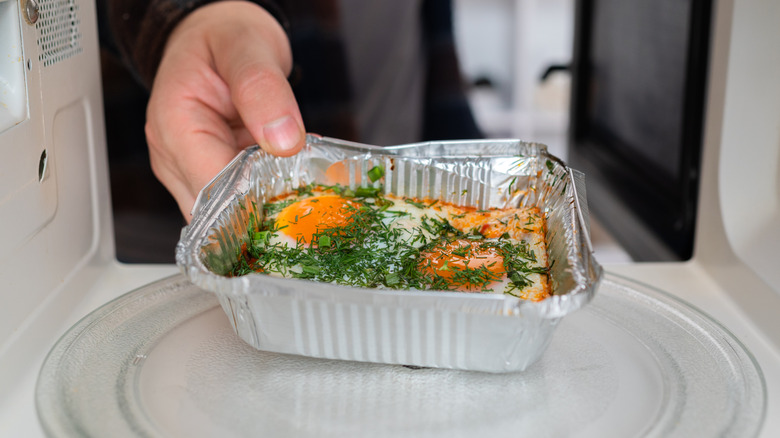
Microwave ovens have become ubiquitous in our modern kitchens and with good reason. They provide many convenient and time-saving services. Not exciting, but so very useful — sort of the ultimate kitchen hack. Unless, of course, you happen to put some metal, like aluminum foil, into the microwave and turn it on. Then the resulting sparks and smoke are a bit too exciting. But what is actually happening in there? (Other than creating an apparent apocalyptic hellscape in a small space.)
What's happening is that the microwave energy is causing electrical charges to build up on the aluminum foil, hence the sparks. To gain a better understanding of the situation, let's take a step back to look at the nuts and bolts of how a microwave oven works. At the heart of a microwave oven is a gizmo called a magnetron. It creates and focuses electromagnetic waves (curiously, a form of radiation) at a frequency of around 2.45 gigahertz. Thanks to the fact that the water molecules, plus fats and sugars, absorb those waves and start rotating as fast as 2.45 billion times per second, we get energy that causes heat.
But what about aluminum foil?
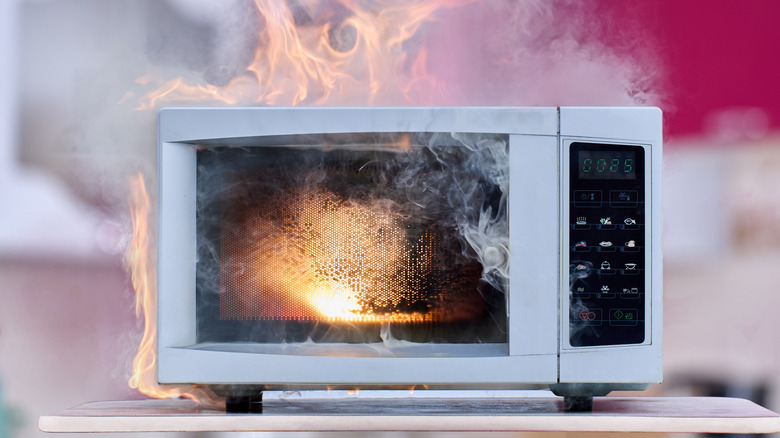
The above is what happens to organic molecules. What happens when those microwaves intersect with aluminum foil? Well, the microwave energy striking aluminum foil — in specific orientations — will attract and excite the electrons, creating a buildup of electricity. If the foil is crinkled you will see electrical sparks jumping from one peak to the next. Those sparks become a fire danger as they can ignite flammable materials or gases.
Another possible event is that the foil may redirect the microwave energy into the output port and cause a short circuit in the magnetron. We are not talking explosions, but fire is still a possibility, and serious repair will be required. Never use a damaged microwave.
The general idea of not putting aluminum foil in the microwave is well known. The confusion comes from the fact that in small amounts and in flat presentations you can put aluminum foil in the microwave, and it can be helpful. (Be careful to keep the edges of the aluminum foil 1 inch away from the sides of the oven.) But, in general, it is best to be avoided. Use glass and microwave safe ceramic instead. Be very careful with plastics to avoid consuming micro plastics created by the microwave.