

Your Pyrex Measuring Cups Might Be Vintage: Here's What To Look For

We may receive a commission on purchases made from links.
It's strange how one scientist on a mission to create a resilient lantern glass for railroads ended up upending the baking and cookware industry — with creative advice and execution from his wife, of course. But that's how Corning Glass Works, the company that created and sold Pyrex, came into being. Ever since, their products have made themselves at home in many kitchens, and chances are you have one of their measuring cups in the dishwasher right now. It's one of the most iconic kitchen products and appliances of all time, after all. If you do own this cup and it wasn't bought recently, or if it's been in the family for a generation or more, you might have a vintage item in your hands.
To approximate your Pyrex measuring cup's vintage status, look for a few things: red markings on the cup, metric measurements, the handle design, and logo placement and casing. Although the manufacturer has intentionally maintained a visually-consistent design through the decades to capitalize on familiarity and reputation, measuring cups have undergone subtle changes ever since, in part to enhance customer experience and usability. By tracking these changes, you can determine whether you've got an authentic vintage Pyrex in your possession.
Vintage Pyrex measuring cups in early years
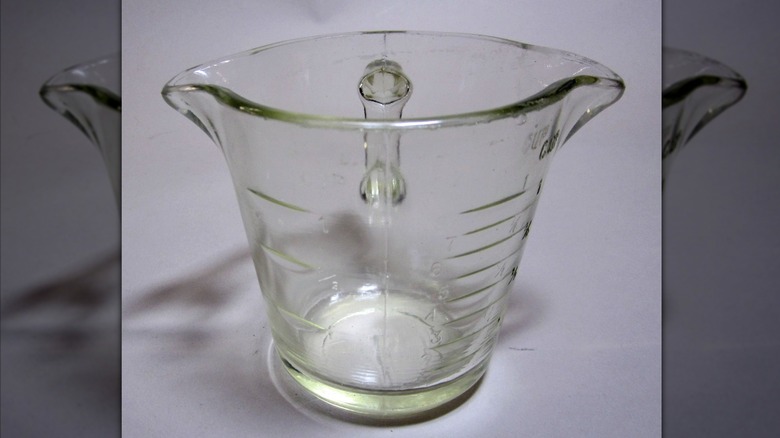
Red-hued measurement labels on clear tempered glass with an open handle and spout is how a Pyrex measuring cup looks today. But when it was created initially in 1925, it looked quite different. As recorded by the Corning Museum of Glass, the first measuring cup had a handle in the center, and you could tip it in either direction because it had two spouts! Fun fact: an 8-ounce cup sold for 50 cents! Given its unique shape, you might've already guessed that it's antique if you still own one.
But the very next year, in 1926, it was made more functional with the handle moved to the side, opposite the lone spout. The cup was still clear, though it had a slight yellow glow and measurements were etched into the glass, so they wouldn't come off even if scrubbed hard. According to Corelle, the current owner of Pyrex, the characteristic red grids were introduced in measuring cups in 1941. So, if you've got etched cups without red marks, they belong to the pre-1940s era.
Compared to clear markings, red enamel drastically improved readability. Measuring cups in the '40s had matching ounce measurements molded on opposite sides. Plus, they had a closed-loop handle, shaped like the letter "D," with curved dents on top and bottom. Pyrex was still trademarked as "PYREX," which was stamped on the bottom along with an item number (532, 516, and 508 for different sizes). Peculiarly, they also carried another bottom embossing: "FOR GENERAL HOUSEHOLD AND PHOTOGRAPHIC USE ONLY." However, if it was a dry measuring cup, it lacked the size stamping or capacity notches, while the bottom was engraved with "T.M. Reg Pyrex" and "U.S. Patent Off."
Metric and logo differences became evident from the 1950s onward
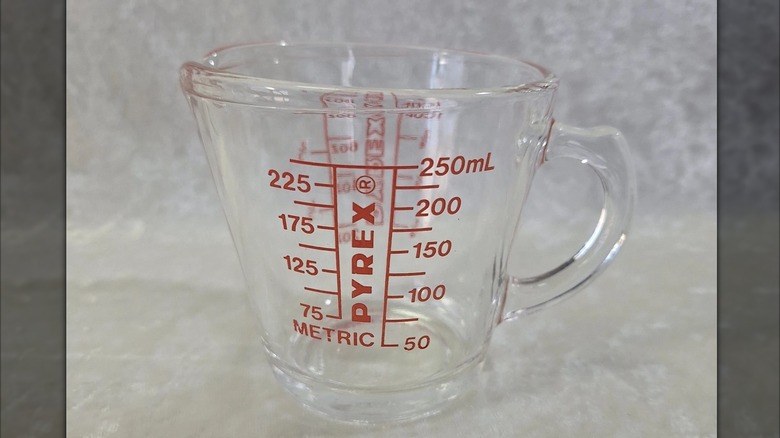
By 1953, "PYREX" was moved from the bottom to the cup's face, placed between capacity indentations on both sides. This continued through the '60s and mid '70s. So, a combination of red decal, D handle, and a capital-case logo would put your cup's vintage between the 1950s and 1970s. Some variants also had "PYREX" printed horizontally, right under the spout.
1975 was the year Pyrex introduced metric measurements on one side, with the printed word "METRIC", while the opposite side retained the cups and ounces system. They also had red barcode stickers, though they haven't survived the test of time. In short, cups with metric measurements, D handles, and evident logos are likely from the '70s or very early 1980s.
However, if your measuring cup has an open handle, it can't be older than 1983. While experimenting with a saucepan's handles, Pyrex realized those were ergonomic enough to offer better control. Better yet, you could stack them one on top of another, unlike D-handled cups, which helped save real estate on shelves and in cabinets. Even though their trademark was switched to sentence casing (as opposed to all capital letters) in the '70s, many measuring cups in the 1980s still showed the brand name in capitals. Also, rather than sitting between measurements, the logo was moved to the top rim, and capacity limits followed thereafter. If your cup shares these characteristics but has the trademark logo in lowercase, it's a recent make. Though if you've had it for over 20 years, it can still qualify for the title of a "vintage item." In case your cup isn't old enough, steel up and use these tips and tricks to hunt for valuable vintage Pyrex at the thrift store or yard and estate sales.