

Give Your Lawn Mower Blades A Quick Refresh With This Common Garage Staple
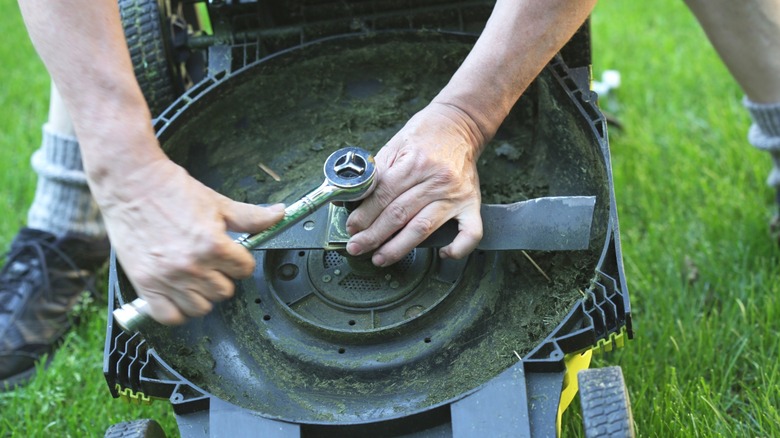
There's no shortage of options to refresh a dull lawn mower blade, but that doesn't mean you couldn't still find yourself in your garage with the piece in hand and no tool to sharpen it, not even a file. In such a situation, look into your woodworking tool chest, because you may be able to do the job with just a sanding machine or sandpaper and a sanding block. Sandpaper is one of the easier and cheaper options to sharpen a lawn mower blade, particularly if you just need to do a quick touch-up.
Sandpaper is somewhat a variation on what is arguably the most preferred method for sharpening a mower blade: using an angle grinder with a flap disc, which consists of a circle of overlapping sandpaper sections. While sandpaper alone is not the best choice for extremely dull or damaged blades needing reshaping or significant grinding, it may be very practical for sharpening a lightly dulled blade. The ideal paper will be designed for metal (such as emery cloth or a ceramic or aluminum oxide sandpaper), but a general-purpose sandpaper can work as well.
The sandpaper grit you choose is also important; if it's too coarse, it will wear too quickly, and if it's too fine, it won't wear quickly enough. A 60-grit paper is a smart starting point, but 80-grit paper or finer might be suitable for a blade in good condition that needs minimal touching up. When the right paper with the proper grit has rigid support, it can wear down metal as effectively as a file, although it may take a little longer if you have to do it without a machine.
Sharpening a lawn mower blade effectively using sandpaper
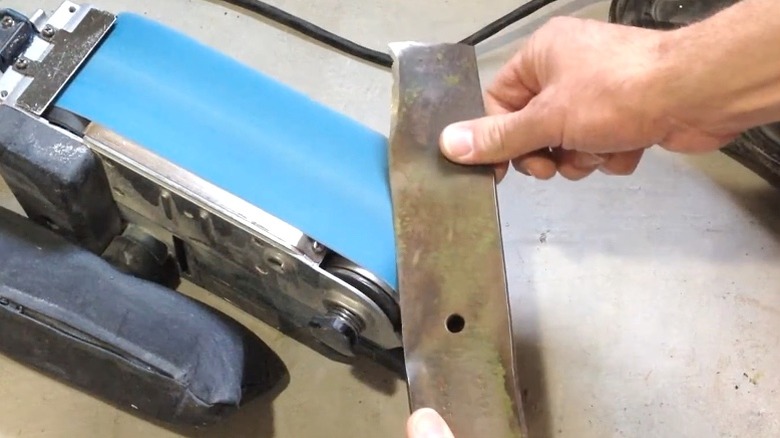
Beyond choosing the right sandpaper, you have to mind the proper sharpening angle to make the chore as quick and effective as possible. Blades typically have a factory bevel between 30 and 45 degrees. Going steeper dulls the blade, and going shallower — or over-sharpening — makes the blade brittle and easily chipped. To maintain the angle, align the sanding tool such that it sits flat against the beveled portion of the blade. Keep it in this position while you're working.
Unlike a file, which only sharpens on the push stroke, sandpaper abrades in both directions, so you can basically rub the paper back and forth against the blade. When choosing a manual tool for the job, be sure it has a hard backing to evenly support the paper. A wooden sanding block (not a foam one) could provide such support, and if you only have sandpaper, you can lay it flat on your benchtop and run the blade over that to sharpen it.
If you have the means, sanding a lawn mower blade with sandpaper works best when you use a power tool, such as a bench sander or an angle grinder with a sanding disk. And in case you don't have a stationary bench sander, you could use a belt sander. Set it on your work bench with the belt facing up, lock the trigger in the "on" position, and move the blade along the belt as you might with a bench grinder. Using the belt sander like this can be risky though, so be sure to wear the necessary safety gear like goggles and gloves and to fix your grinder in place with clamps or a DIY stand to keep it from shifting.