

Metal Files Vs. Rasps: What's The Difference

Files and rasps have been around since ancient Egyptian craftsmen were shaping wood and metal in the Bronze Age. As an expert woodworker, I have been aware of the confusion between rasps and files for the last 40 years. Really, rasps and files can be better thought of as wood vs. metal files — rasps are made for shaping wood, and files are made to shape and polish metal. Files, typically mill files, have teeth that are very fine. Rasps, when compared to mill files, have much larger teeth. The teeth are also often placed in a less orderly fashion and have observably larger gaps between them. I use both regularly — rasps for woodworking and files to sharpen cutting edges on everything from woodworking tools to lawn mower blades.
Why the confusion? That is easy to understand. First of all, they look remarkably similar. They are long, narrow, and have a tang and/or handle. Second, although they are designed for different materials, they are used with almost exactly the same technique: They cut on the push stroke, and they shape their respective materials with teeth ground into the body of the tools. Adding to the confusion, you can properly use mill files on wood occasionally. (Important Note: If you use a rasp on metal, you will ruin it.)
All about mill files
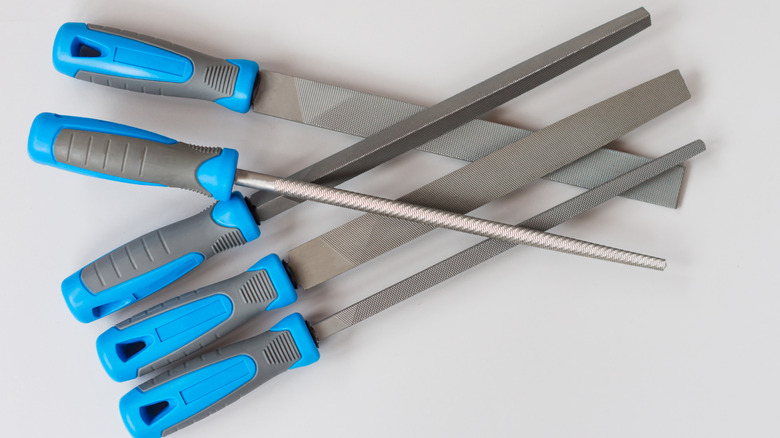
Mill files, AKA metalworking files, have finely ground teeth in a single- or double-cut pattern. There are some who make a distinction between mill files and flat files, but as the technical term for shaping metal is milling, the category extends across the tools. Superior quality mill files are made from high-carbon steel. Steel can be milled (shaped) into myriad forms, and for that reason you will find mill files formed in a variety of shapes in addition to the standard flat version. Round, half-round, square, and triangular are the primary shapes you'll find in the market. There are other specialty shapes that are not as common.
You'll also find mill files divided by grade ratings. Grades indicate how aggressively the file will cut, with teeth ranging from rough to smooth. Although you will get some variation in these terms, a good grade list (from coarse to fine) is: Rough, Coarse, B*****d, Second Cut, Smooth, and Dead Smooth. Sometimes, a file will have an edge or face with no teeth ground into it, often called a safe edge. This is deliberate to give the operator a surface that will not harm an area of their work that should not be filed. Triangular files, for instance, nearly always have a safe edge.
Rasps are not files
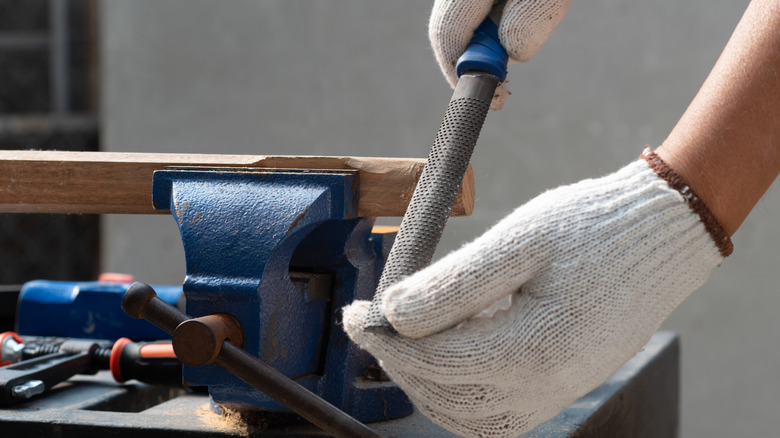
Rasps are shaped generally the same as files, with one big exception. Their teeth are much larger, allowing them to grab and shape wood fibers more effectively. Each tooth is roughly triangular in shape. Rasps are made exclusively to shape wood and similar products (MDF, for example). If you use a rasp on a piece of steel, the results will be disastrous for the piece of steel and the rasp. If you put a mill file next to a rasp, you will see that the rasp teeth are not only much larger but are spaced more randomly, with large gaps between them. Those gaps are intentional, preventing the wood dust from clogging the spaces. When the gaps fill up, the teeth struggle to cut the wood fibers. That is why, while you may occasionally use a mill file to smooth a section of wood, the wood dust will quickly fill the small file teeth.
Rasps come in a similar collection of shapes: round, half-round, flat, and triangular. There is also a very popular rasp called a Four-in-Hand rasp that has four different cutting faces in differing grades of roughness, flat and rounded — it is a very handy woodworking tool. Rasps also have different levels of roughness, generally two: a B*****d and a Smooth/Second cut. The names may vary regionally. There are many different kinds of wood shaving and shaping tools, and rasps have stood the test of time and are one of the most effective.