

The Beautiful Blue Antique Plate Pattern Thrifters Dream Of Finding

When it comes to china patterns, many thrifters find it hard to resist the classic combination of crisp cobalt blue against pristine winter white. Blue Willow's romantic chinoiserie motifs are perhaps the most familiar, while Spode and Wedgewood designs featuring pastoral scenes and botanicals in bloom can also be valuable vintage dinnerware to buy at the thrift store. But there's another, lesser-known icon that can make a major statement on both your table and your bank account. Thrifters dream of finding pieces of Meissen Blue Onion, the beautiful blue antique plate pattern that sells for hundreds or even thousands of dollars.
Meissen porcelain originated in Germany (then Saxony) in the early 1700s thanks in large part to Johann Friedrich Böttger, an apothecary's apprentice turned alchemist who intrigued Augustus the Strong with claims that he could turn ordinary metals into gold. While that pursuit didn't pan out, Böttger did figure out how to create hard-paste porcelain that rivaled the wildly popular Chinese stoneware of the time. Drawing on this discovery, another Meissen artist, Johann Gregor Höroldt, developed blue underglazing that mimicked the rare and highly-coveted luxury porcelain being imported from China for wealthy European families.
Around 1739, Höroldt created the Blue Onion pattern by adapting Ming Dynasty-period motifs for plate, cup, and bowl designs that are sought after by antique collectors nearly 300 years later. According to Ariel Davis of The Brooklyn Teacup, "That adaptation led to one of porcelain's greatest cases of mistaken identity ... The famous 'onions' aren't onions at all. Most historians believe the rounded fruits in the original Chinese design were pomegranates and peaches, symbols of prosperity, fertility, and longevity in Chinese culture."
How to value and authenticate Meissen's Blue Onion China
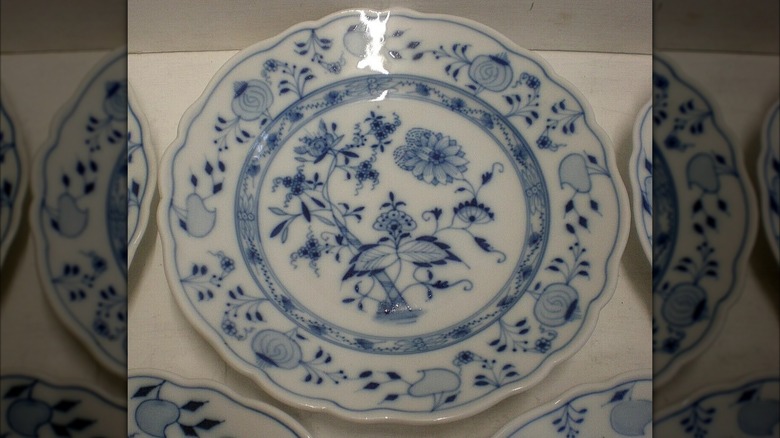
Meissen's Blue Onion pattern is among the thrifted blue-and-white dishware that might be more valuable than it looks. Single plates can retail for between $200 to $500. As of writing, a single square bowl is available from TableArt for $615. Full table sets for six, consisting of teacups and saucers along with breakfast, dinner, and soup plates, are currently listed on Etsy for almost $800. One unusual find, an hors d'oeuvre set on Chairish, is estimated to fetch $850. Finding a complete estate-sized set of Meissen Blue Onion at a thrift store could fetch you close to $3,000 on the replacement market.
The German manufacturer is still producing Blue Onion porcelain today, and it can be found on over 700 different vintage porcelain pieces, from gravy boats to candlesticks. That can make it more likely that your dream of finding the beautiful plate pattern at your local thrift store, flea market, or estate sale comes true. However, as with most valuable vintage patterns, the age, size, condition, rarity, presence or lack of maker's marks or signatures, and set completeness are among the many factors that will influence what you could expect collectors to offer.
Knowing how to tell if old china dishes are valuable is one thing, but distinguishing the Blue Onion pattern from the extremely derivative Japanese adaptation of it, known as Blue Danube, is another. Fortunately, despite featuring nearly identical motifs, you simply need to flip pieces over to determine the maker. Blue Danube china will be labeled as such inside a blue rectangle near the word "Japan," while authentic Meissen pieces feature the factory's signature crossed-swords mark.